Why meaning matters
The Qurʼān asks to be understood: كِتَابٌ أَنزَلْنَاهُ إِلَيْكَ مُبَارَكٌ لِّيَدَّبَّرُوا آيَاتِهِ وَلِيَتَذَكَّرَ أُولُو الْأَلْبَابِ — “A blessed Book that We have sent down to you, so that they reflect on its āyāt, and so that people of understanding take heed.” (Ṣād 38:29)
Yet many of us recite beautifully in a language we do not yet understand. That is no failing; it is where most of the world’s Muslims begin. But reflection needs meaning, and meaning is closer than it looks.
This guide covers what a translation is and is not, how to choose and switch among Qiraa’s 58 translations, when to open a tafsīr and which one, how the meaning under each āyah helps you memorize and tell look-alike āyāt apart, and a 15-minute routine you can begin today.
A translation is a meaning
A translation carries the meaning, not the Qurʼān itself
Allah describes His Book as Arabic: إِنَّا أَنزَلْنَاهُ قُرْآنًا عَرَبِيًّا لَّعَلَّكُمْ تَعْقِلُونَ — “We have sent it down as an Arabic Qurʼān, so that you may understand.” (Yūsuf 12:2) The Qurʼān is the Arabic words, recited as they were revealed. A translation is a careful human rendering of their meaning in another language, which is why so many printed translations call themselves translations “of the meanings”.
That difference shapes how you use one:
- Recite the Arabic; read the translation. Your prayer is recited in Arabic. A translation explains what you recite; it does not stand in its place.
- Name the translator. Every translation makes choices. When you quote a meaning, say whose rendering it is. Qiraa shows the translator under every edition for the same reason.
- Expect translations to differ. An Arabic word can carry more than one shade, and a translator has to choose. Where two translations disagree, open a tafsīr rather than picking the one you prefer.
- Keep the Arabic in front of you. Read the meaning beside the āyah, not instead of it, so your eyes stay on the words of the Qurʼān.
Qiraa does not write translations or tafsīr. It shows published works, keeps a copy on your device once fetched, and names who wrote them.
58 translations
Qiraa’s translations: 58 in 53 languages
Qiraa offers 58 translations in 53 languages. English begins with The Clear Quran by Dr. Mustafa Khattab: first in the list, and the translation Qiraa starts you with.
Four more English translations sit beside it: Pickthall (Marmaduke Pickthall), Abdel Haleem (M. A. S. Abdel Haleem), Yusuf Ali (Abdullah Yusuf Ali) and Mufti Taqi Usmani.
Then come the other languages, with one or two well-known translations each. A few of them:
- Urdu: Jalandhry and Maududi
- Indonesian: Kementerian Agama, from the Indonesian Ministry of Religious Affairs
- Turkish: Diyanet İşleri
- Bengali: Muhiuddin Khan
- French: Hamidullah
- Malay: Basmeih
- Persian: Fooladvand
- Somali, Swahili and Hausa: Mahmud Muhammad Abduh, Al-Barwani and Gumi
- Bosnian, Albanian and Russian: Korkut, Sherif Ahmeti and Kuliev
- Chinese, Spanish and German: Ma Jian, Isa García and Bubenheim & Elyas
Each row shows the language in its own name and then the translator — “Français · Muhammad Hamidullah” — so the long list reads in blocks, one language at a time.
How to choose one
- Your strongest language first. Choose the language you think in, even if you read others well. Meaning should land without effort.
- Plain words for daily reading. A clear, modern rendering is the easiest to read beside the Arabic every day.
- Keep one for a season. If you switch every week, the meaning of familiar āyāt keeps shifting under you. Keep one translation while you memorize a portion.
- Compare when an āyah puzzles you. A second translation, read beside the first for a single āyah, often shows where the Arabic holds more than one shade. That is the moment to open a tafsīr.
Switching it
How to turn on and switch a translation
- Open any page in the reader and tap Tools at the top.
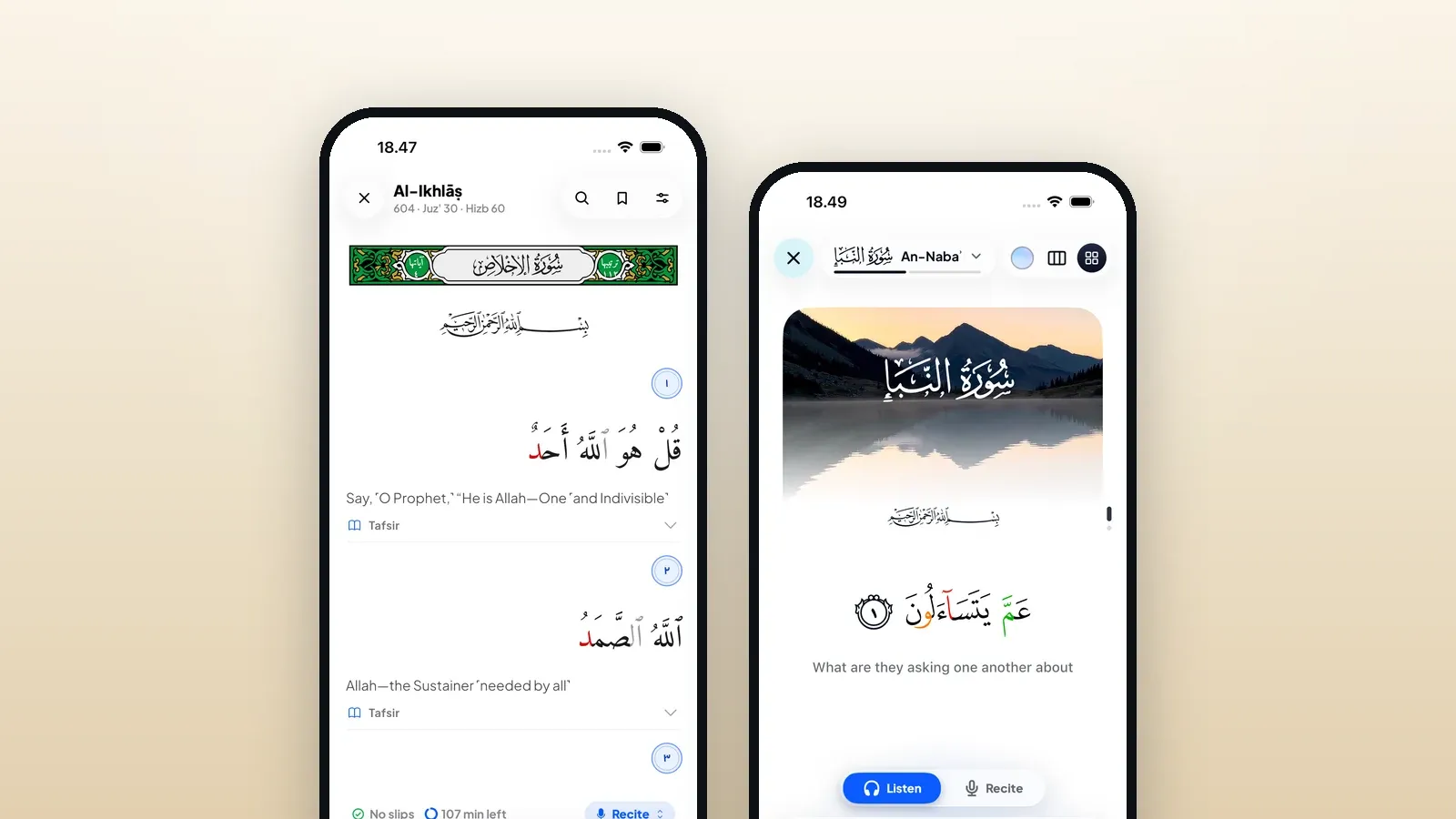
- Under How it reads, choose Text with meaning. The muṣḥaf page becomes flowing text with the meaning under each āyah.
- Tap Translation source and choose an edition.
- To return to the printed page, choose Muṣḥaf page, or Off in the list of translations.

Tools › How it reads › Text with meaning, and the Translation list, where The Clear Quran comes first.
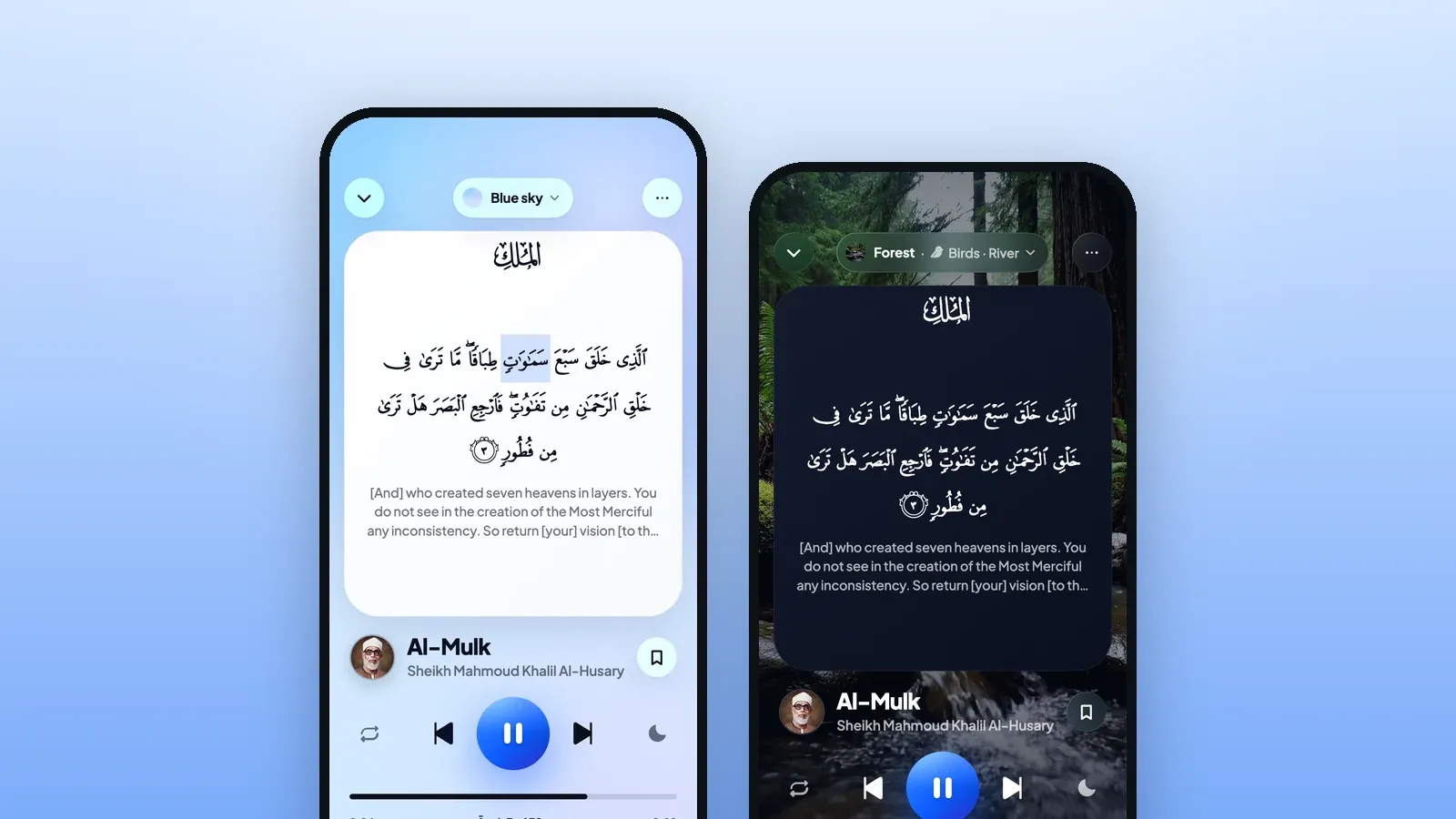
Your choice travels with you. The same translation gives the meaning under the āyah in the Listen face (Show the meaning, in its ⋯ menu) and under a one-āyah card in the Hifz trainer. When the app is in English, an āyah you long-press carries its meaning too, and so do its look-alikes.
Each āyah’s translation is fetched the first time you open it, then kept on your device.

Text with meaning: the Arabic first, the translation under it, and a Tafsir line under every āyah.
Tafsīr
Tafsīr: when you want the why
A translation tells you what an āyah says. A tafsīr explains it: what its words mean, the light other āyāt and the Sunnah shed on it, the events it came down with, and what scholars drew from it.
Where to open it
- On any āyah: long-press it on the page and tap Tafsir.
- From Tools: under Navigate, Tafsir opens the āyah you are on.
- In the Hifz trainer: the Tafsīr seat at the start of a sitting opens the tafsīr of the first āyah, and tapping an āyah on a card offers Tafsīr too.

One more way in: in Text with meaning, open the Tafsir line under an āyah and the commentary unfolds in place — Ibn Kathīr, by default.
The sheet shows the āyah, the work you are reading and the commentary beneath. Tap the work’s name to Choose a tafsir:
- Arabic: al-Tafsīr al-Muyassar (King Fahd Complex), Ibn Kathīr, al-Saʿdī, al-Ṭabarī, al-Qurṭubī and al-Baghawī.
- English: Tafsir Ibn Kathir; Al-Mukhtasar (Concise), from the Tafsir Center for Quranic Studies; Ma’arif al-Qur’an by Mufti Muhammad Shafi; and Tazkirul Quran by Maulana Wahid Uddin Khan.
Qiraa starts you on Ibn Kathīr: in Arabic if the app is in Arabic, in English otherwise. A work kept on your phone is marked Available offline, and every page ends with a line saying where the commentary comes from and that Qiraa did not write it.
Which tafsīr for which moment
- A short answer, every day: al-Muyassar in Arabic, or Al-Mukhtasar (Concise) in English. A few lines per āyah, easy to read beside your portion.
- A fuller, accessible explanation: al-Saʿdī, a modern tafsīr known for its clarity.
- The narrations behind an āyah: Ibn Kathīr, who explains the Qurʼān by the Qurʼān and by reports from the Prophet ﷺ and the early generations.
- Deeper study: al-Ṭabarī, al-Qurṭubī and al-Baghawī, classical works best read slowly — and, where you can, with a teacher.
Tafsīr is scholarship. When an āyah carries a ruling, or the commentaries take different views, ask someone qualified rather than settling it alone.
Meaning on the card
The meaning under a one-āyah card
In the Hifz trainer, a portion practised One by one gives each āyah its own card, and under the āyah sits its meaning, in the translation you chose. It is on by default.
To change it, open Settings on the dock. Under On the card, the Meaning switch reads “Under a one-āyah card.” The same group holds Text size, Colour tajwīd and Colour look-alikes. With a keyboard, M turns the meaning on and off.

In the Hifz trainer the meaning sits under a one-āyah card; the Meaning switch is in Settings › On the card.
A card that holds several āyāt together shows the Arabic alone.
Use it without leaning on it
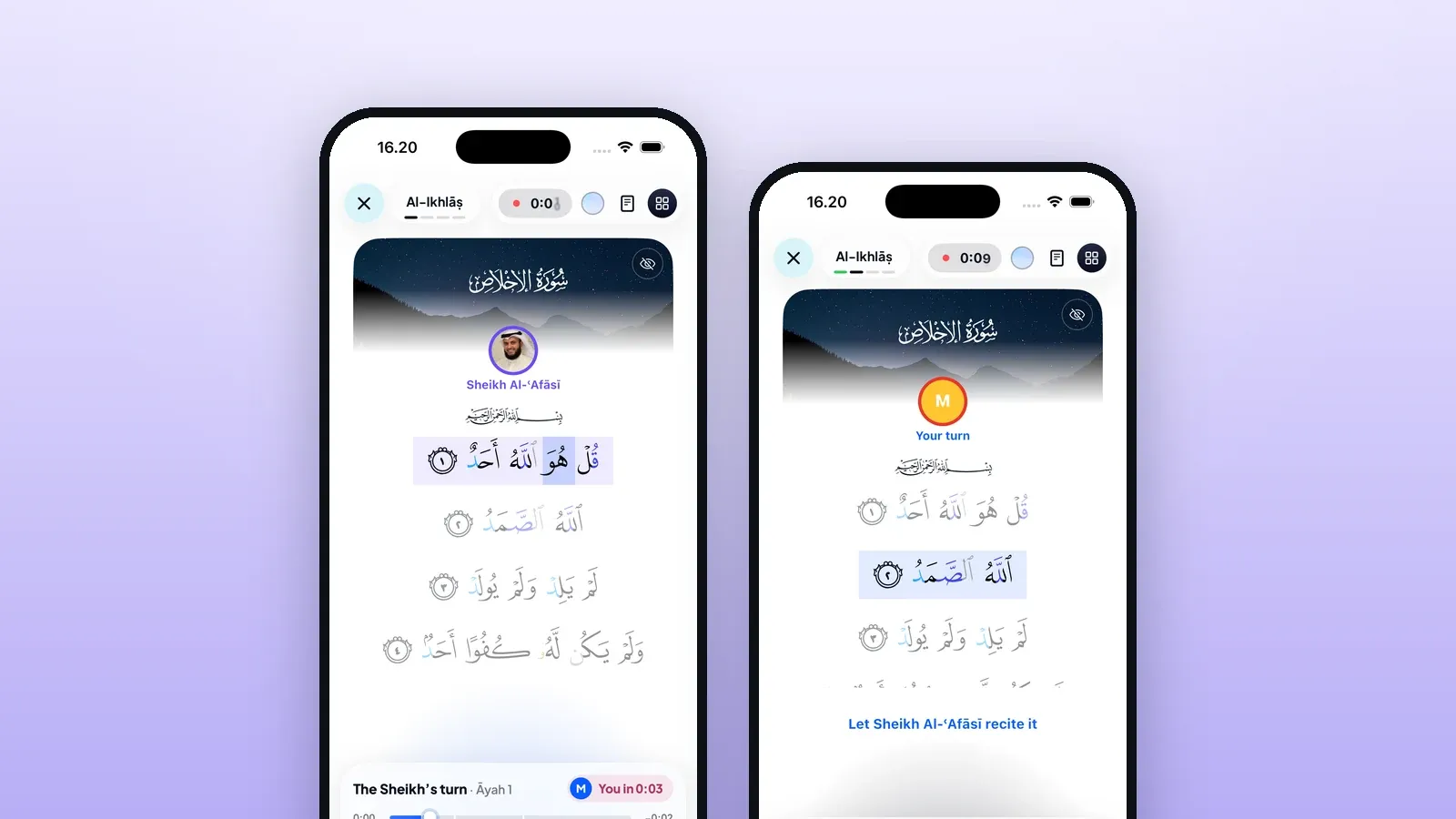
- Read it during the Sheikh’s turn. While he recites, glance down and take in what the āyah says. Then let the meaning carry you into the words.
- Recite from the Arabic, not the translation. On your turn your eyes belong on the āyah, or on nothing if it is hidden. If you catch yourself reading the translation to find the next Arabic word, switch Meaning off for that sitting.
- If Arabic is your language, remember that the meaning line comes from the translation list. For a short Arabic explanation, open the āyah’s Tafsīr and choose al-Muyassar.
Meaning and memory
How meaning holds memory, and tells look-alikes apart
Meaning gives memory a thread. When you know where a passage is going — a story, an argument, a promise, a warning — the next āyah is less of a guess. Many learners find that reading the meaning of a portion before memorizing it helps the āyāt link together.
Meaning matters most where the sound is almost the same. The Qurʼān returns to phrases with small, deliberate changes: in Qiraa’s own data, 988 āyāt — 16% — share their first four words with another āyah.
One example
Two āyāt recall the same rescue from the people of Pharaoh:
- al-Baqarah 2:49 begins وَإِذْ نَجَّيْنَاكُم مِّنْ آلِ فِرْعَوْنَ يَسُومُونَكُمْ سُوءَ الْعَذَابِ يُذَبِّحُونَ أَبْنَاءَكُمْ. Allah is speaking, to the Children of Israel: “And when We saved you from the people of Pharaoh, who afflicted you with the worst torment, slaughtering your sons…”
- Ibrāhīm 14:6 begins وَإِذْ قَالَ مُوسَىٰ لِقَوْمِهِ اذْكُرُوا نِعْمَةَ اللَّهِ عَلَيْكُمْ إِذْ أَنجَاكُم مِّنْ آلِ فِرْعَوْنَ. Mūsā is speaking, to his people: “Remember Allah’s favour upon you when He saved you from the people of Pharaoh…” — and it goes on to وَيُذَبِّحُونَ أَبْنَاءَكُمْ, with a wāw.
Know who is speaking and the words sort themselves: “We saved you,” نَجَّيْنَاكُم, in al-Baqarah; Mūsā’s “He saved you,” أَنجَاكُم, in Ibrāhīm. A meaning you understand is a landmark that sound alone cannot give you.
Look-alikes in Qiraa
Long-press an āyah on the page. If it has look-alikes, Look-alikes appears in the menu with their number. The sheet sets them side by side: “In blue, where this āyah parts; on grey, where the other does.” When the app is in English, each carries its meaning in your translation. Drill them apart takes them into the Hifz trainer to practise. And in the trainer, Colour look-alikes (Settings › On the card) marks the words other āyāt share, and the word where this one parts.
A 15-minute routine
A 15-minute “read with meaning” routine
For a portion you are about to memorize, or one you recite in prayer. Five āyāt is plenty.
- Meaning first (4 minutes). In the reader, open Tools › How it reads › Text with meaning, and read the translation of the whole portion once, slowly, like a short passage of prose.
- One tafsīr (4 minutes). Choose the āyah you understood least, long-press it and open Tafsir. Read the short tafsīr of that one āyah.
- Listen with meaning (3 minutes). Tap Listen on the dock and keep the meaning shown. Follow the Arabic while you know what it says.
- Back to the Arabic (3 minutes). Switch to Muṣḥaf page and recite the portion aloud from the page, slowly, with the meaning in mind.
- One line (1 minute). On paper, write a single sentence: what does this passage ask of me? Long-press the āyah and tap Mark if you want to come back to it.
If you are memorizing, go straight from here into the Hifz trainer with Meaning on. The āyāt may still be new to your tongue, but they are no longer strangers to your mind.
Questions
Questions people ask about reading with meaning
Is reading a translation the same as reading the Qurʼān?
No. The Qurʼān is the Arabic words as they were revealed. A translation is a person’s rendering of their meaning: a help to understanding that does not take the Arabic’s place in recitation or in prayer. Read it beside the Arabic, and name the translator when you quote it.
Which English translation does Qiraa start with?
The Clear Quran by Dr. Mustafa Khattab. Pickthall, Abdel Haleem, Yusuf Ali and Mufti Taqi Usmani are there too. Change it in the reader under Tools › Translation source.
How many translations does Qiraa have?
58 translations in 53 languages, from Urdu, Indonesian, Turkish and French to Swahili, Bosnian and Chinese. Each row names its language and translator, and each āyah’s translation is fetched once and then kept on your device.
What is the difference between a translation and a tafsīr?
A translation renders what an āyah says. A tafsīr explains it: its words, its setting, the light other āyāt and the Sunnah shed on it, and what scholars drew from it. In Qiraa, long-press an āyah and tap Tafsir.
Which tafsīr works can I read in Qiraa?
Ten. In Arabic: al-Tafsīr al-Muyassar, Ibn Kathīr, al-Saʿdī, al-Ṭabarī, al-Qurṭubī and al-Baghawī. In English: Tafsir Ibn Kathir, Al-Mukhtasar (Concise), Ma’arif al-Qur’an and Tazkirul Quran.
Will the meaning under the card make memorizing harder?
Usually it helps: knowing what an āyah says gives memory a thread and tells look-alikes apart. Read it during the Sheikh’s turn and recite from the Arabic. If you find yourself reading the translation to recall the words, switch it off in Settings › On the card › Meaning.