Start with the ear
Before the Qurʼān was a book in anyone’s hands, it was a voice. The Prophet ﷺ received it by listening, his Companions received it from his mouth, and every reciter you can hear today learned it the same way, from someone who recited it to him. Listening is not the easy part you do before the real work. It is where correct recitation begins.
This guide is about listening well in Qiraa: choosing among its 32 reciters, following the words as he recites, setting repeats and pace so that listening teaches rather than simply plays, and making listening the first step of memorizing. It ends with a plan for one week.
One honest note first. A recording cannot hear you. Listening trains your ear; reciting to a teacher corrects your tongue. You need both, and this guide is about the first.
Why listen first
Why listening comes first
Scholars of recitation call it talaqqī: receiving the Qurʼān by ear from someone who received it the same way. Allah taught the Prophet ﷺ to listen first and recite after: لَا تُحَرِّكْ بِهِ لِسَانَكَ لِتَعْجَلَ بِهِ إِنَّ عَلَيْنَا جَمْعَهُ وَقُرْآنَهُ فَإِذَا قَرَأْنَاهُ فَاتَّبِعْ قُرْآنَهُ — “Do not move your tongue with it to hurry it. Upon Us is its gathering and its recitation. So when We have recited it, follow its recitation.” (al-Qiyāmah 75:16–18)
Listening was never only for beginners. The Prophet ﷺ asked ʿAbdullāh ibn Masʿūd to recite to him, and when Ibn Masʿūd asked how, when it had been revealed to him, he said that he loved to hear it from someone else (al-Bukhārī 5050; Muslim 800). Listening is worship in its own right: وَإِذَا قُرِئَ الْقُرْآنُ فَاسْتَمِعُوا لَهُ وَأَنصِتُوا لَعَلَّكُمْ تُرْحَمُونَ — “When the Qurʼān is recited, listen to it and be silent, so that you may be shown mercy.” (al-Aʿrāf 7:204)
What the ear learns that the page cannot show
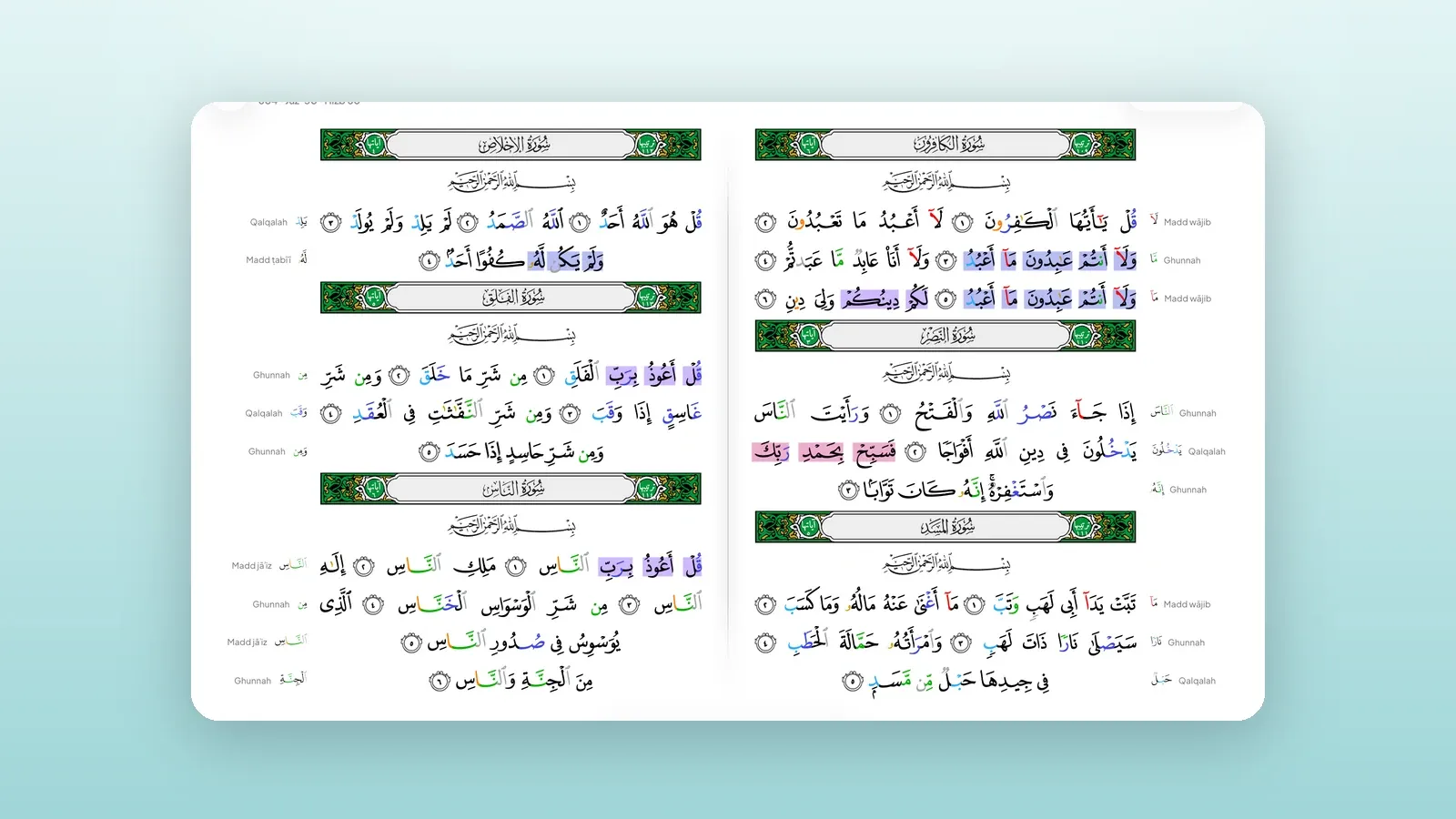
A printed muṣḥaf shows letters, vowels and the small signs of tajwīd. It does not show how long a madd is held, how a nūn melts into the letter after it, how a heavy letter fills the mouth, or where a reciter stops and begins again. Those you learn by hearing them, many times, from a voice you trust.
The ear also learns the shape of an āyah: its rhythm, where it rises and where it settles. That shape becomes part of memory, which is why a sūrah you have heard many times arrives half-familiar when you come to memorize it.
What listening cannot do
Listening cannot tell you whether your own recitation matches what you heard. For that you need someone who listens back: a teacher above all, and between lessons a listener who can follow you. Hear it, say it, be heard — this guide is about the first of the three.
Choosing a reciter
Choosing among 32 reciters
Qiraa has 32 reciters, each named with his title and his Arabic name, each with a short line describing his recitation. All recite in the riwāyah of Ḥafṣ ʿan ʿĀṣim, the reading of the muṣḥaf the app shows.

Every reciter by his title, with his photo and a line on his recitation — Imam of Makkah, Murattal, Melodic murattal.
We will not rank them: they are masters of the same Book with different gifts. The useful question is what you want your listening to do this month.
Murattal and mujawwad
Most recordings in Qiraa are murattal: steady, measured recitation, close to the pace you would recite at yourself. Five are mujawwad, marked “Mujawwad · melodic”: slower and more melodic, with long breaths between āyāt. Mujawwad is beautiful for unhurried listening; for memorizing, a murattal is usually easier to follow and to copy.
Ten of them, and what each suits
- Sheikh Mahmoud Khalil Al-Husary — “Teaching murattal”: “the measured teaching muṣḥaf a generation learned from,” and Qiraa’s default. A natural first choice for memorizing, with every letter and every length plain.
- Sheikh Ayman Suwayd — also “Teaching murattal”: a second teaching voice to learn from.
- Sheikh Mishary Al-Afasy — “Warm · measured”: “a warm, contemporary murattal loved worldwide.” Easy company for daily listening and for review.
- Sheikh Abdul Basit (murattal) — “Classic murattal”: “a golden-age master famed for breath and control.” Hear how a long passage is carried on one breath.
- Sheikh Al-Minshawi — “Melodic murattal”: “a deeply melodic, moving murattal.” For days when you want the recitation to reach the heart as well as the ear.
- Sheikh Abdurrahman As-Sudais and Sheikh Maher Al-Muaiqly — “Imam of Makkah,” imāms of the Grand Mosque. If you know their voices from the prayers there, that familiarity makes it easier to begin.
- Sheikh Ali Al-Hudhaify — “Imam of Madīnah,” imām of the Prophet’s Mosque: the same help, for those who know his voice.
- Sheikh Muhammad At-Tablawi and Sheikh Mustafa Ismail — “Mujawwad · melodic,” for quiet, reflective listening.
How to hear them and choose
In the reader, open Tools and tap the reciter under Listen, or tap Play on the dock and choose Reciter. The Reciters sheet shows each Sheikh with his photo, his name and his style; Search reciters finds him by his English or Arabic name. Tap a Sheikh to hear a short sample. His card offers Hear a sample — Al-Ikhlāṣ 112:1, recited the same way by every reciter, so the voices compare cleanly — and Choose this reciter.

In the reader, Tools › Listen: tap the reciter to change him, or Play this page.
For memorizing, keep one reciter for a whole portion: your ear copies his pauses and lengths, and switching halfway blurs what you copy. Changing the reciter changes only what you hear. When you recite, Qiraa follows your own voice, and the reciter plays no part in it.
Word by word
Following the recitation word by word
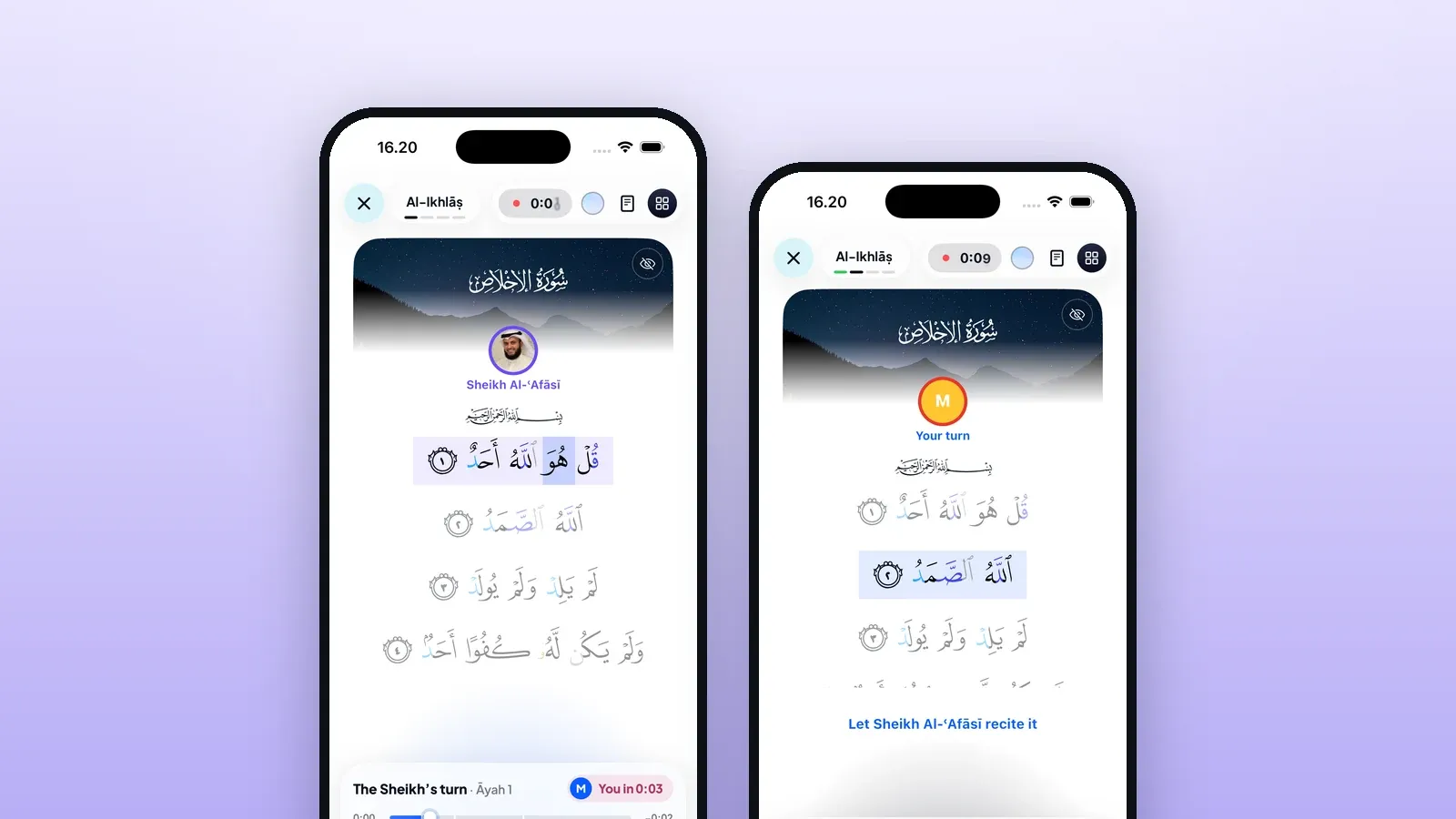
When a Sheikh recites in the reader, the āyah he is on is lit with a soft band on the muṣḥaf page, and the page turns with him. Eyes on the printed words while the voice carries them: it is the simplest way to tie a sound to its letters.

While a Sheikh recites, his āyah is lit on the page — and with word timings, the word he is on.
Nine reciters have word timings: Sheikh Mahmoud Khalil Al-Husary, Sheikh Mishary Al-Afasy, Sheikh Abdul Basit (murattal), Sheikh Al-Minshawi, Sheikh Abdurrahman As-Sudais, Sheikh Saud Ash-Shuraim, Sheikh Maher Al-Muaiqly, Sheikh Ali Al-Hudhaify and Sheikh Yasser Al-Dossary. With them, a word marker moves across the page on the very word he is saying, placed by timings aligned to his own recordings.
With the other reciters, and on any āyah a timing does not cover, Qiraa lights the āyah and does not guess the word. A highlight that ran ahead of the voice, or dragged behind it, would teach your eye the wrong word at the wrong moment.
Three ways to follow
- Eyes on the word. Play a page and keep your eyes on the moving word — not ahead of it, not behind. That habit joins what you hear to what you read.
- Hide, then listen. Tap Hide on the dock and the words step back. Play the page and, with a reciter who has word timings, each word returns as he says it. Try to say the next word in your head before it appears: where you cannot, you have found the next thing to learn.
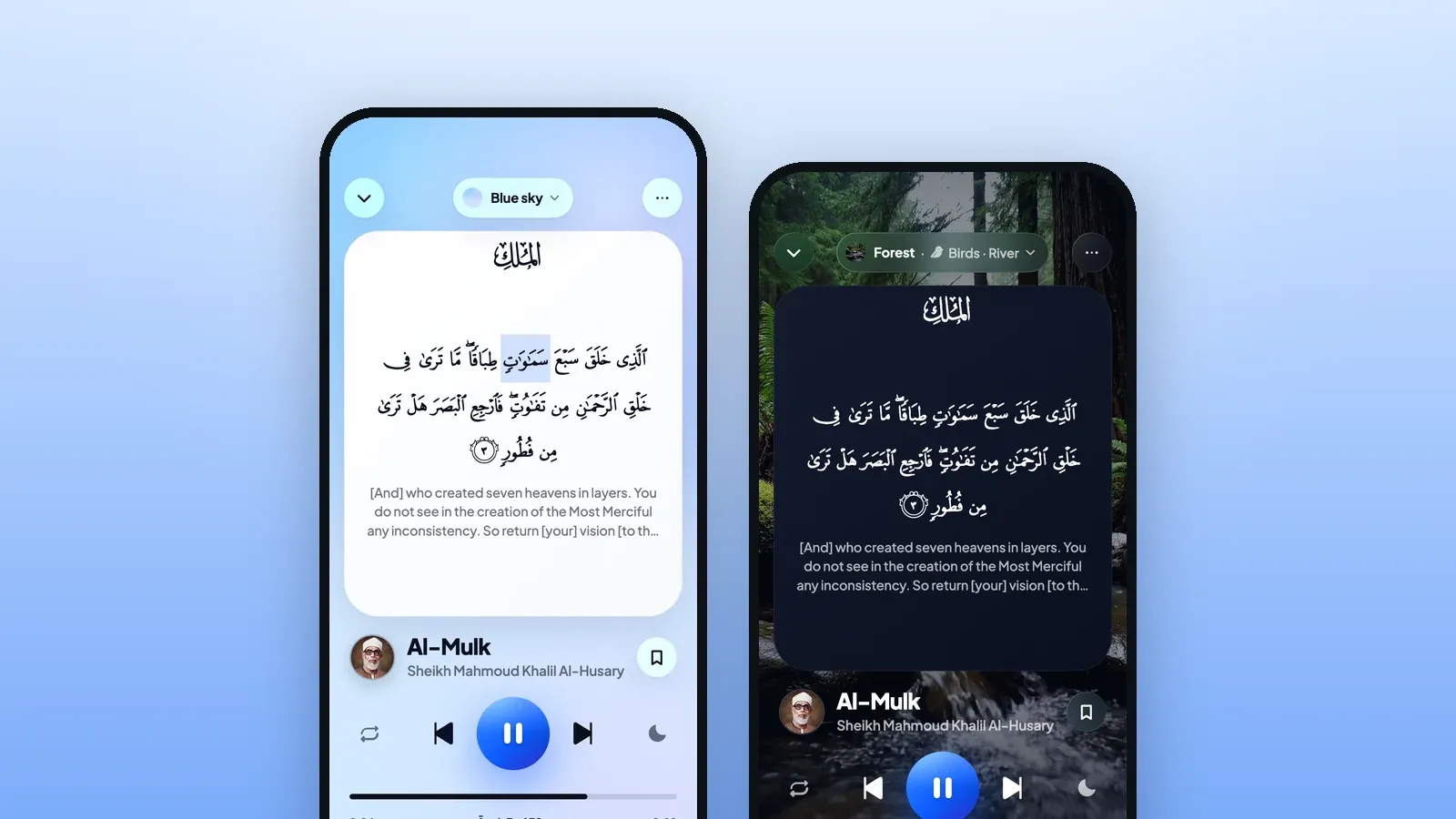
- The Listen face. Tap Listen on the dock and the page gives way to a listening room. A Qurʼān card holds the āyah in the muṣḥaf’s own script, lighting word by word as he recites when he has timings, with its meaning beneath. Back to the page folds it away.
Repeat and pace
Repeat, pace, and a pause that makes room for you
Listening teaches most when it repeats. Tap Play on the dock to open Playback, where you set what plays and how:
- Listen to — From and To, or one tap for Page, Surah, Juz', Quran or Custom.
- Each āyah · Plays — once, or 2, 3, 4, 5 or 10 times, with Fewer and More.
- Then — Go on moves straight to the next āyah; A breath leaves a short pause; Your turn leaves a pause as long as the āyah itself, room to say it back.
- Playback speed — a Pace from 0.25× to 2×.
- Stop after — Off, This āyah, the sūrah, 15 minutes, 30 minutes or 1 hour.

Playback, from Play on the dock: what to play, how many times each āyah, and what comes after — Go on, A breath, or Your turn.
Settings that teach
- A new portion: 3 plays, Your turn, and a pace of 0.75×. Listen, then say the āyah back in the gap while you look at the page.
- Review: 1 play, Go on, at 1×, to check that the portion still flows.
- One stubborn āyah: long-press it on the page and tap Repeat. It plays again and again until you stop it.
About speed: slowing down helps you hear each letter and each length in a new portion. But the Sheikh’s own pace is the one you will recite at, so return to 1× once the words have settled.
The Listen face keeps the same help within reach: Repeat each āyah (Off, Each āyah ×3, Each āyah ×5 or Each āyah, on a loop) and a Sleep timer that stops at the End of this āyah, at the end of the sūrah, or after 5, 15 or 30 minutes, or 1 hour.
Scenes and sound
Scenes and sounds that keep you with the recitation
The Listen face is a room as well as a player: a scene behind the Qurʼān card, and a quiet sound under the voice if you want one. Tap Scene & sound at the top to choose.
- Scenes: Blue sky by day (Dark blue at night), Dawn, Clouds, Stars, Rain, Sea, Forest, Desert and Hearth.
- Sounds: Rain, Waves, Wind, Birds, Hearth, Night and River — or Silence. Tap more than one to mix them.
- Match the sound to the scene: birds at dawn, waves by the sea.
- Mix sets two levels: the Qur’an, and the sound Under the voice.

Scene & sound sets a room behind the Qurʼān card and, if you like, a quiet sound under the voice.
From the ⋯ menu, Hide the Qur’an card keeps only the room and the recitation.
Sound, with adab
The recitation is why you are there. Keep any sound low, under the voice and never over it, and if it pulls your attention from the words, choose Silence. A quiet, steady sound helps some people on a noisy train or in a busy home; others listen best with nothing. Both are fine. The scene and the sound serve your attention; they are not part of the recitation.
The Hifz trainer has its own Scene & sound in a sitting’s settings, with the same sounds, and each sūrah’s scene sits across the top of its card.
Listen to memorize
Listening as the first step of memorizing
When you memorize, listening is still where you begin; it simply moves closer to your own turn.
On the reading screen: the mic’s modes
Hold the mic on the reading screen and its modes rise out of it: Recite, Listen, Memorize, Halaqah and Test me. Slide to one and let go, then choose a portion: This page, This sūrah, Your memorization, Today’s lesson, or Choose….
- Listen — “Sheikh Al-Ḥuṣarī reads, you follow,” with your own Sheikh’s name in it. Tap the mic and he recites the portion, each āyah three times. Listen only plays; it does not use the microphone.
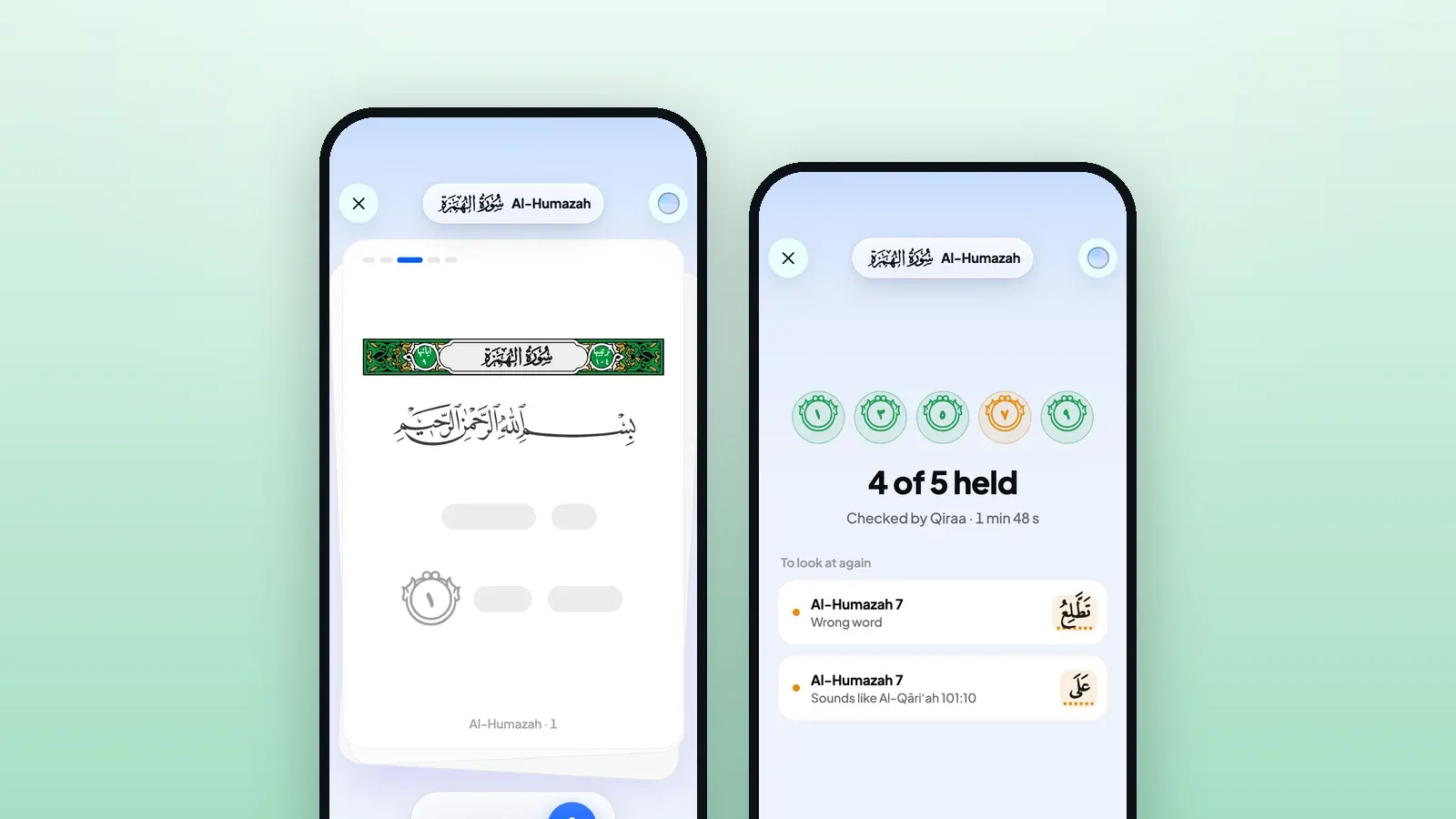
- Memorize — “Listen · Repeat · Recall.” The Sheikh reads each āyah three times (“Listen 1 of 3”), then you tap My turn and recite it from memory, with Hear it, Slower, Peek and Again beside you. Slips are kept in Mistakes, to practise.
In the Hifz trainer: the Sheikh’s turn
Each card in the Hifz trainer begins with the Sheikh’s turn, and you decide how long it lasts. Open Settings on the dock; under Qāriʾ you will find He repeats each āyah — Once, ×3, ×5 or ×10 — and Speed: 0.75×, 0.85×, 1× or 1.25×. Slower on the dock plays the āyah at 0.75×. When his turn is done, tap My turn.
- Once for review, when the āyah is already yours.
- ×3, where the trainer starts, for āyāt you half know.
- ×5 or ×10 for a new or long āyah, or one you keep mixing up.
A rule of thumb: listen until the āyah is familiar, not until it is perfect. When you can say the next word just before he does, it is time for your turn.
A week of listening
A one-week listening plan
Fifteen minutes a day, one portion — half a page to a page — and one reciter for the whole week.
- Day 1 · Choose. Hear three Sheikhs recite Al-Ikhlāṣ 112:1 and choose one murattal voice you can follow. Play your portion once at 1×, eyes on the moving word or the lit āyah.
- Day 2 · Repeat. In Playback, set Each āyah to 3 plays and Then to A breath.
- Day 3 · Say it back. Set the pace to 0.75× and Then to Your turn. In each gap, say the āyah back while looking at the page.
- Day 4 · Listen for meaning. Open the Listen face with the meaning shown and the sound low or off. Listen once only to understand what is said.
- Day 5 · Hide. Tap Hide and play the portion again. Try to say each word in your head before it appears.
- Day 6 · Memorize. Hold the mic, choose Memorize, and work through the portion: three listens, then your turn, āyah by āyah.
- Day 7 · Review and be heard. Play the whole portion once at 1×, then recite it to a teacher, or to someone in your family with a muṣḥaf open.
Next week, take a new portion and move this one into review, with the same Sheikh.
Questions
Questions people ask about listening
Which reciter should I choose for memorizing?
A steady murattal you can follow easily, kept for the whole portion. Qiraa’s default, Sheikh Mahmoud Khalil Al-Husary, is marked “Teaching murattal” and is a natural start. Hear a few Sheikhs recite Al-Ikhlāṣ 112:1 and choose the one whose pace you can copy.
Why does the moving word appear for some reciters and not others?
The moving word needs word timings, and nine of Qiraa’s 32 reciters have them, aligned to their own recordings. With the others, Qiraa lights the whole āyah and does not guess the word, because a highlight out of step with the voice would teach the wrong word.
Does the reciter I choose change how Qiraa checks my recitation?
No. The reciter is what you hear. When you recite, Qiraa follows your own voice, and the reciter you chose plays no part in it.
Is listening enough to memorize the Qurʼān?
Listening makes the words familiar and trains your ear, which is why it comes first. Memory is built by repeating and recalling, and correctness by being heard. Begin each portion by listening, then move to your own turn, and recite to a teacher when you can.
What speed should I listen at?
For a new portion, a little slower — 0.75× — with a pause after each āyah to say it back. Return to 1× once the words have settled, because the Sheikh’s own pace is the one you will recite at.
Does listening in Qiraa use my microphone?
No. Listening only plays the recitation. The microphone is used only when you choose to recite, and Qiraa asks before its AI listens to your voice.