In short
For as long as the Qurʼān has been learned, it has been learned in circles. A teacher sits, the students sit round him, and the recitation passes from voice to voice. One recites while the others listen; a word slips, it is put right gently, and the next person takes the turn. Arabic calls that circle a ḥalaqah.
Qiraa’s Halaqah is built on that shape. You choose a portion, a Sheikh whose recitation leads the circle, and the people who sit with you on one phone. The turns go round, Qiraa listens to each one and marks what slipped, and at the end it shows who recited what.
This guide walks through every choice in the order you meet it, then gives three ways to use it: alone with a Sheikh, with a friend, and as a family after Maghrib. One thing first: it is practice between lessons, not a teacher’s circle. It cannot grant an ijāzah.
What a halaqah is
What a halaqah has always been
The word ḥalaqah means a ring. In the mosques it came to mean a circle of learning: people sitting round a teacher, the Qurʼān passing between them. Many of us first met the Qurʼān that way, cross-legged on a carpet, waiting for our turn.
The Prophet ﷺ described such a gathering: no people gather in one of the houses of Allah, reciting the Book of Allah and studying it together, except that tranquillity descends upon them, mercy covers them, the angels surround them, and Allah mentions them among those with Him (Muslim 2699).
He also loved to hear the Qurʼān from someone else. He asked ʿAbdullāh ibn Masʿūd to recite to him, and Ibn Masʿūd recited from Sūrat an-Nisāʾ until he reached ﴿فَكَيْفَ إِذَا جِئْنَا مِن كُلِّ أُمَّةٍ بِشَهِيدٍ وَجِئْنَا بِكَ عَلَىٰ هَٰؤُلَاءِ شَهِيدًا﴾ (an-Nisāʾ 4:41) — and the Prophet’s eyes were flowing with tears (al-Bukhārī 5050, Muslim 800).
Three things made those circles work, and the Halaqah in Qiraa is built round them:
- Listening is part of reciting. ﴿وَإِذَا قُرِئَ الْقُرْآنُ فَاسْتَمِعُوا لَهُ وَأَنصِتُوا لَعَلَّكُمْ تُرْحَمُونَ﴾ — “When the Qurʼān is recited, listen to it and be silent, so that you may receive mercy” (al-Aʿrāf 7:204). In a circle you listen more than you recite, and the listening teaches.
- Turns keep everyone awake. You follow every āyah, because the next one may be yours.
- Correction is gentle. A good teacher says the word correctly, the student repeats it, and the circle carries on. The aim is the next turn, not the last mistake.
And a circle does what a lone memorizer cannot do for himself: someone else hears you.
Where to find it
Where the Halaqah lives in Qiraa
There are two ways in.
- The Halaqah tab, among the app’s main tabs: the full circle, with a portion you choose, a Sheikh and the people who sit with you. Most of this guide is about this door.
- The reading page. Hold the mic in the dock and the modes rise out of it; slide to Halaqah — “Take turns, āyah by āyah” — and let go. The Sheikh reads an āyah, then it is your turn, right on the page.
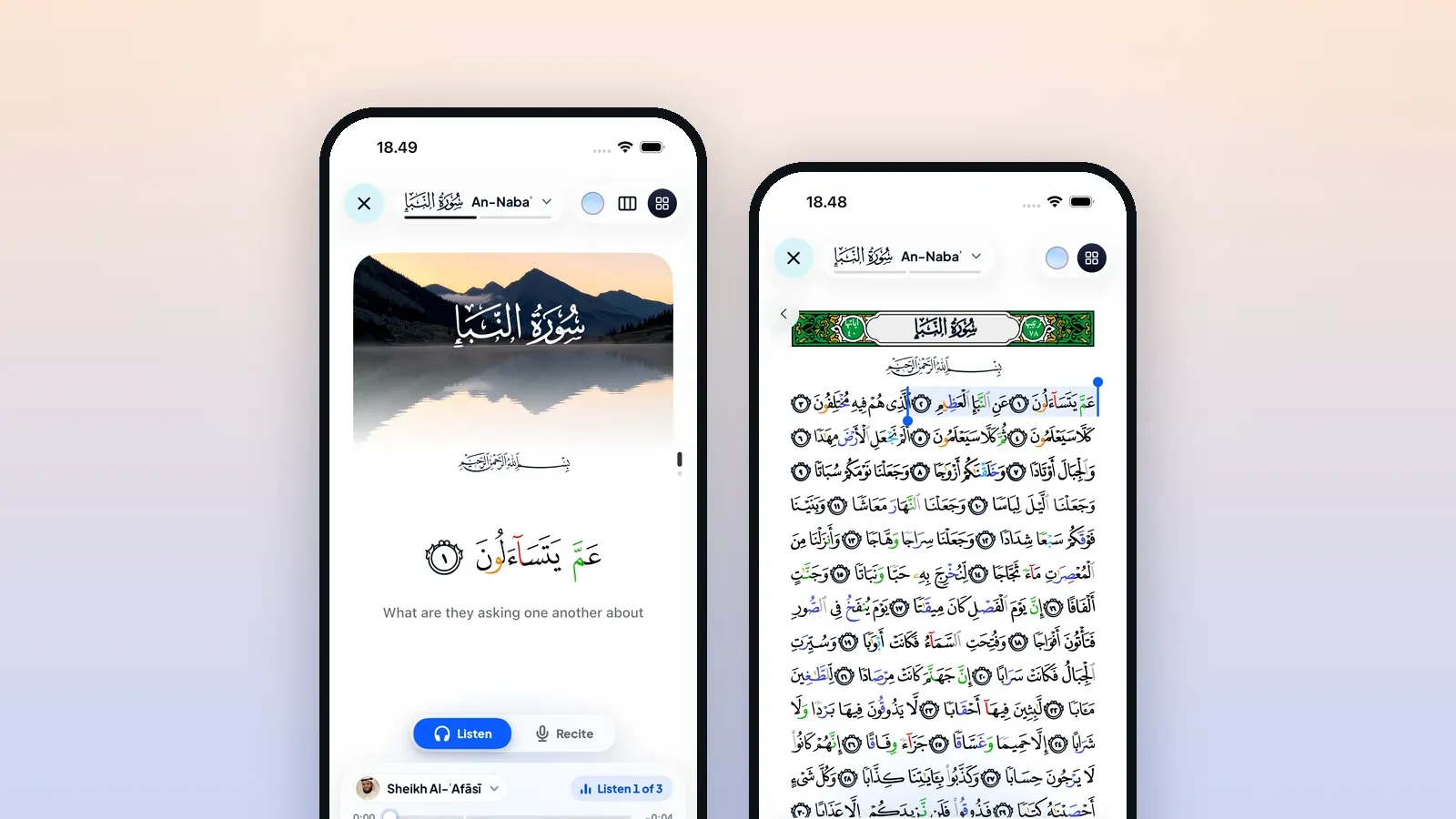
The tab opens on a scene you can swipe sideways to change, with the sūrah’s name large in the middle and your portion and Turns at the top. At the foot, one card steps through Portion → Sheikh → Circle. Next moves you along; on the last step it becomes Begin.

The Halaqah tab: a scene with the sūrah’s name, then three steps — Portion, Sheikh, Circle.
Portion, Sheikh, Circle
Setting up: Portion, Sheikh, Circle
1. Portion
Tap Change to choose what the circle will recite: a sūrah, a juzʼ or a page, and inside a sūrah a range of āyāt. Start small — a few āyāt everyone knows, or this week’s portion.
2. Sheikh
The Sheikh leads the circle with his recorded recitation, so there is always one correct voice in the room. The step shows the reciter you listen to, with his photo and style; Change chooses another. In the room he is named with his title, as in “Sheikh Al-Ḥuṣarī”.
Once someone else sits with you, his seat’s menu offers Leave the circle, and the step then reads “Not in this halaqah”, with Add to bring him back. For most circles, keep him: he is the one who recites a slipped āyah correctly.
3. Circle
Here are the seats, in the order the turns will go. You are always in the circle; Add someone seats another person:
- A family learner, shown by name when recitation checking is on for them. Their turns count toward their own progress.
- A guest: type a name under A guest and tap Add. “Everyone recites on this phone; Qiraa hears each turn.” A guest’s turns are marked like anyone’s, but kept on no one’s record.
- On their phone: Invite to watch gives you a link and a six-character code, and someone far away taps Join with a code on their own Halaqah tab. “They’ll see each word as it’s said” and hear the Sheikh, but they take no seat. Inviting asks you to be signed in.
The circle holds up to four seats: you, the Sheikh and up to two more people. In a seat’s menu, Recites first moves that person to the front, and a guest can be removed. Then tap Begin, and the room opens straight into the sitting.
Turns and words
How the turns go, and who sees the words
Turns
Tap Turns at the top of the tab, or find it in the room’s Settings:
- Āyah each — “Turns pass after each āyah.” The classic circle, and the place to begin.
- Page each — “Turns pass after each page.” For revising a portion everyone already holds.
- Together — “Everyone as one voice; the Sheikh keeps his turns.” Often the easiest for young children.
Beside it, Who begins chooses the voice that opens the circle. Beginning with the Sheikh is gentle: everyone hears the first āyah before anyone has to say one.
Words, shown or hidden — for each person
In the room’s Settings, under Words, each person has a row: Shown or Hidden. Hidden means they recite from memory and the words appear only as they are said — so a child can read while a parent recites from memory, in the same circle. If someone is stuck, Peek word shows the next word; it counts as a slip, so the record stays honest about the help.
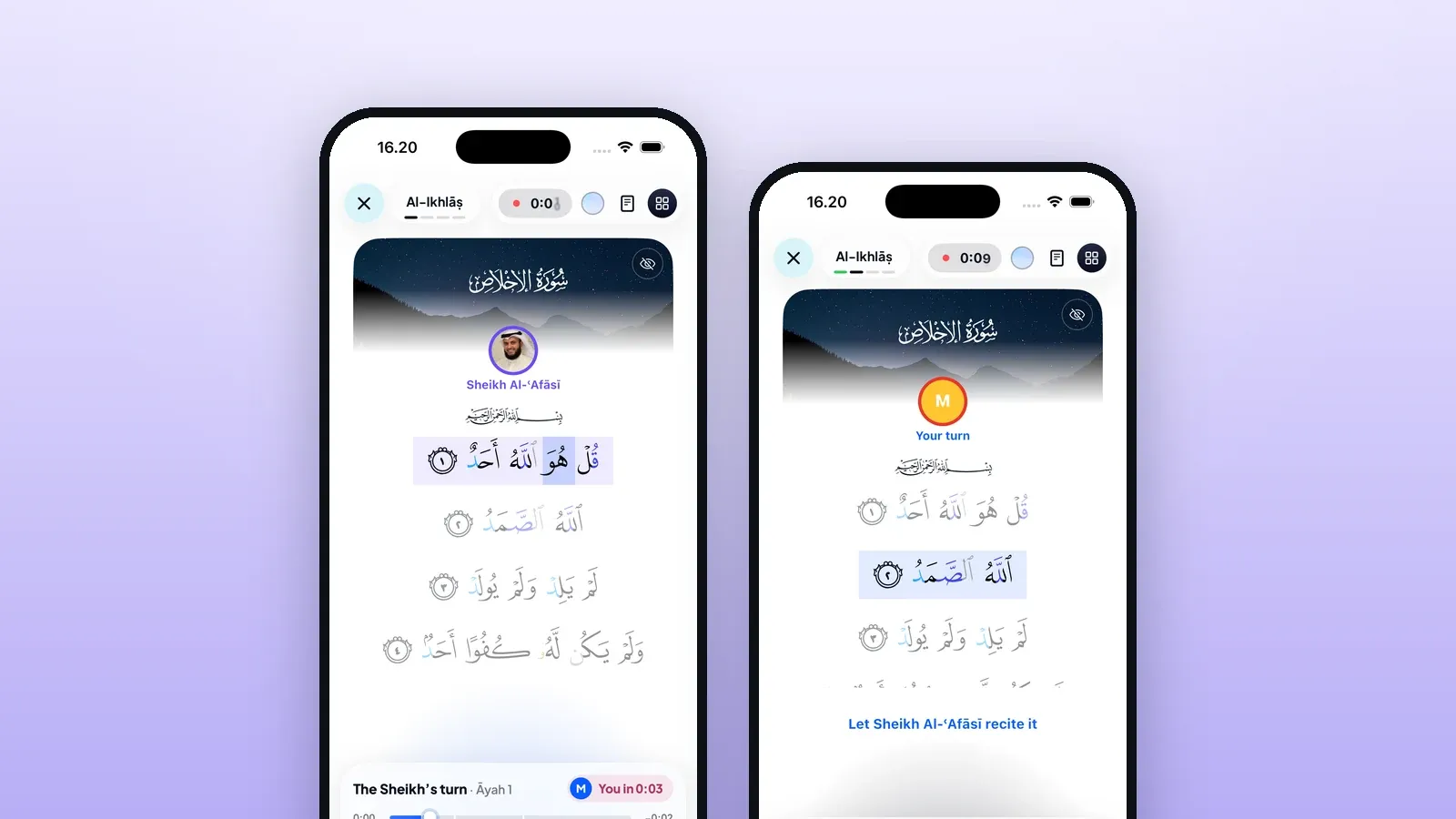
The room always says whose turn it is — “Your turn”, “Zayd’s turn”, “The Sheikh’s turn” — and Qiraa follows each reciter word by word.

The room always says whose turn it is. If a turn falls silent, Let Sheikh Al-‘Afāsī recite it is one tap away.
When someone slips
When someone slips: Gentle, Coach or Strict
This is the heart of a halaqah, and you choose it under If someone slips:
- Gentle — the Sheikh recites the slipped āyah correctly, and the circle carries on. Best for children, guests and first sittings.
- Coach — the person tries again a few times (“Once more · try 2 of 3”); if it still slips, the Sheikh recites it and the circle moves on.
- Strict — the same tries, but if the āyah is still not right, the sitting stops there. For revision you trust, when you want to find exactly where it breaks.
It is the same dial the reader and the Hifz trainer use, so a change here changes it there too.
Before you begin, Each āyah sets how often a person’s āyah comes round: Once; Twice, whatever the first try was like; or Until held, where a slipped āyah returns until it is held — and after several tries the Sheikh recites it, so a sitting never loops for ever.
What the room says
A good turn is Held. A slip is named plainly: “One word: …”, or “One letter: ص, not س”. When Qiraa is not sure, it does not invent a mistake: it says “A word to check”, or in a noisy room “Hard to hear · carrying on”. When the Sheikh recites a slipped āyah, the line reads “Sheikh Al-Ḥuṣarī recites it”, and under it, “Listen, then carry on”.
And when a turn falls silent in the middle of an āyah, the room offers help: “Let Sheikh Al-ʿAfāsī recite it”. One tap, and the Sheikh recites it. Nobody has to say “I’ve forgotten” out loud.
In the room
The rest of the room
Open Settings in the dock — the sheet is called Halaqah settings — for the rest:
- Qāriʾ pace: 1× or 0.75×, to slow the Sheikh for a new portion or for children.
- Text size, under On the card: Small, Default, Large or Larger.
- Recite with the qāriʾ, to bring the Sheikh back if he stepped out.
- Book: One page or Two pages, on a wide screen.

One sheet for the whole circle: turns, who sees the words, text size, what happens after a slip, and the Sheikh’s pace.
Hide the card into Nuri’s ball
Tap Hide card on the band at the top of the card, and the whole card gives way to Nuri’s ball. It swells with whoever is reciting — your voice on your turn, the Sheikh’s when he recites. Tap the ball, and the card comes back. It helps a child who reads ahead, and revision you want to do by ear.

Tap Hide card and the card gives way to Nuri’s ball, which moves with the voice of whoever recites.
Asking before listening
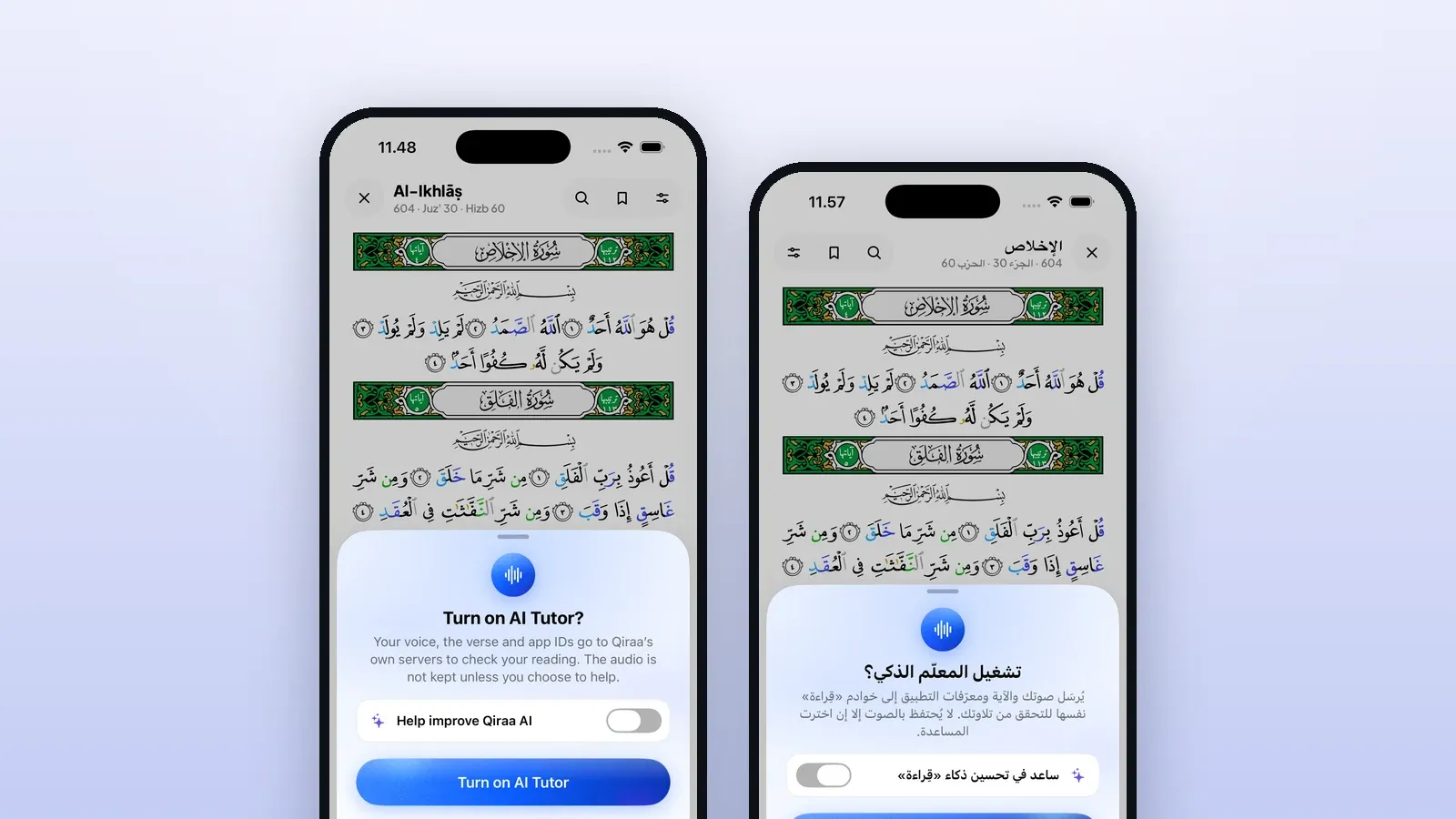
Qiraa asks before its AI listens to your voice, and its production service keeps no recording of your recitation. If you would rather it did not listen, the circle still runs: “Lite: on this device, nothing checked”.
Leaving and the close
Leaving, and who recited what
Tap ✕, and Qiraa asks: “Leave the sitting?”
- Keep for later — “Go on from āyah 12.” Next time the tab says “Paused at āyah 12”, with Continue or Start over.
- End and review — “See who held what.”
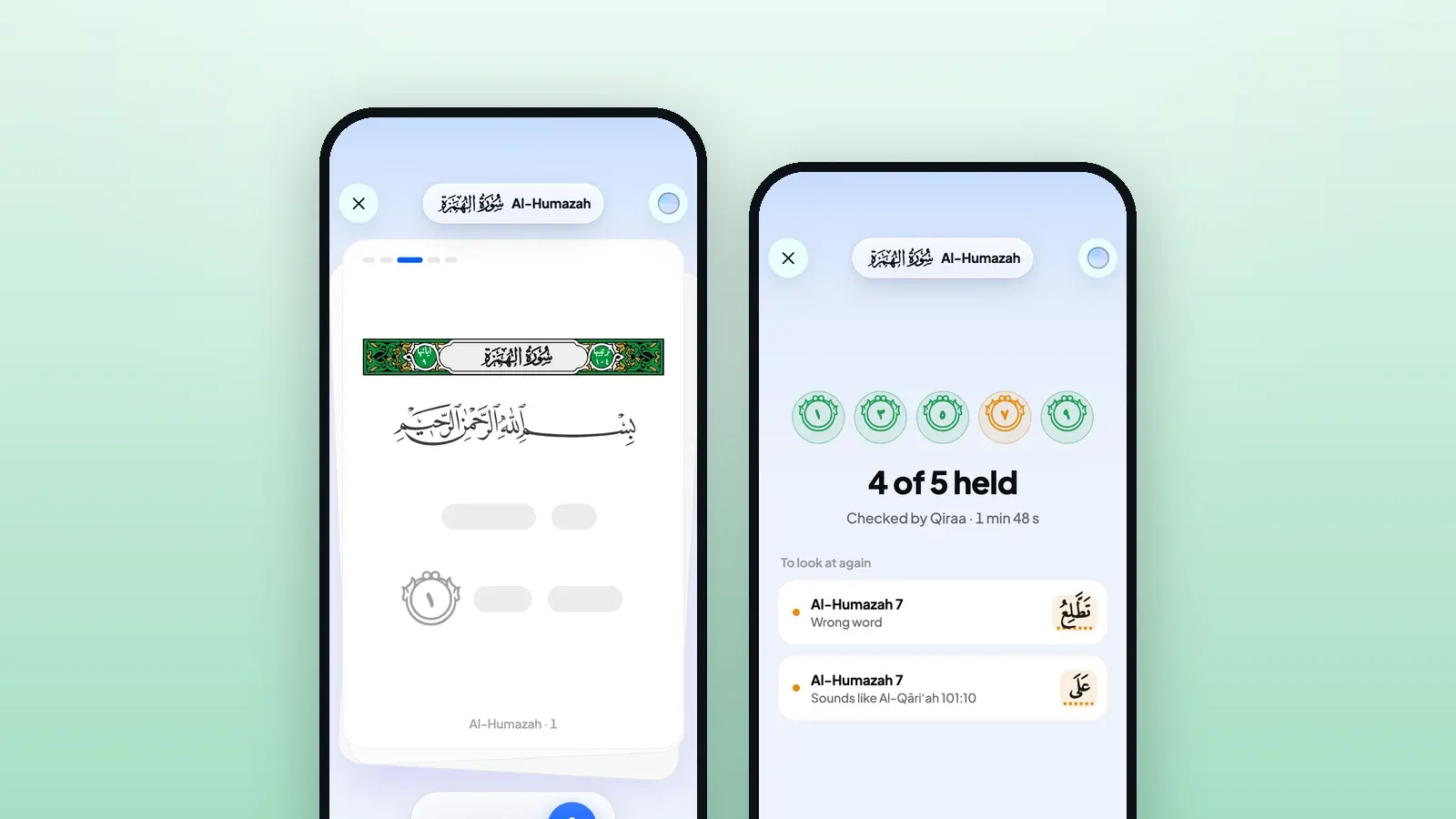
The close is how the old circles ended too: who recited, and how it went. It shows how many āyāt were held and how many slipped (the Sheikh’s never count); who sat, how many āyāt and how long — “You, Ahmad and Zayd · 4 āyāt · 3:12”; and a card for each person who recited, with a tick for each āyah held and a mark for each slip.
Under a slip, ▶ plays that person’s own take, or the Sheikh’s where none was kept, and “Zayd, again” starts a short round of only Zayd’s slipped āyāt — “Your āyāt again” on your own card. Again runs the circle once more; Done closes it. Your slips are kept in your Mistakes, and a family learner’s in theirs.
Three ways to use it
Three ways to sit in a halaqah this week
1. Alone with a Sheikh
Two seats, you and the Sheikh: the closest thing to sitting before a teacher who recites a line and waits for yours.
- Portion: the āyāt you are memorizing this week.
- Turns: Āyah each, the Sheikh beginning. Words: Hidden for you.
- If someone slips: Coach. Each āyah: Until held. Qāriʾ pace: 0.75× while the portion is new.
He recites an āyah, you recite the next. Afterwards, put yourself first with Recites first and go round again, so his āyāt become yours. Ten minutes of this after Fajr is real revision.
2. With a friend
Two people memorizing the same portion can keep each other honest. Sit side by side, one phone between you.
- Circle: add your friend as a guest. Words: Hidden for both of you.
- Turns: Page each if you both hold the portion; Āyah each if it is new.
- If someone slips: Strict, to test a portion you both believe you hold. Where it stops is where you work next.
A friend in another city can watch along if you Invite to watch, following each word as you say it — though they cannot take turns from their phone.
3. As a family after Maghrib
Many homes already have this moment: between Maghrib and ʿIshāʾ, everyone in. A short halaqah fits there.
- Portion: a short sūrah from Juzʼ ʿAmma that the children are learning.
- Circle: you and up to two children as family learners, so each child’s recitation counts toward their own progress. Keep the Sheikh.
- Turns: Āyah each for older children; Together for little ones.
- Words: Shown for a child still reading; Hidden for one who knows it.
- If someone slips: Gentle. Qāriʾ pace: 0.75×. Text size: Larger.
For small children, try Hide card: they like to make Nuri’s ball grow. At the close, read out who recited what, let each child hear their slipped āyah again, and end on something they held.
What it is not
What the Halaqah is, and what it is not
The Halaqah in Qiraa is a way to practise together between lessons: one correct voice to follow, an ear on every turn, and an honest record at the end.
It is not a teacher’s circle. It cannot grant an ijāzah, it does not replace a qualified teacher’s ear for the makhārij and the finer rules of tajwīd, and it should never be the only one who hears you. If you have a teacher, bring them what the close showed you. If you do not have one yet, let the Halaqah keep you reciting aloud, in turns, until you find one.
Questions
Questions people ask about the Halaqah
What is a halaqah?
A circle of learning: people sitting together, usually round a teacher, reciting the Qurʼān in turns and listening to one another. In Qiraa, the Halaqah is that circle on one phone — a portion, a Sheikh’s recitation leading it, and the people who sit with you — with Qiraa listening to each turn.
How many people can sit in a Halaqah?
Up to four seats: you, the Sheikh, and up to two more people on your phone, either family learners or guests. Others can watch along on their own phones with a code; they see each word as it is said, but they do not take a seat.
Does everyone need their own phone or account?
No. Everyone in the circle recites on the same phone, and Qiraa hears each turn. A family learner’s turns count toward their own progress; a guest’s are kept on no one’s record. Only someone watching from far away uses their own phone, through “Join with a code”.
What happens when someone makes a mistake?
You choose it under “If someone slips”. Gentle: the Sheikh recites the āyah correctly and the circle carries on. Coach: the person tries again a few times, then the Sheikh recites it. Strict: the same tries, and if it is still not right, the sitting stops there. When Qiraa is not sure, it says so instead of marking a mistake.
Can children use the Halaqah?
Yes, with a parent beside them. Choose Gentle, keep the words Shown for a child who is still reading, and set the Qāriʾ pace to 0.75× and the Text size to Larger. Hide card turns the card into Nuri’s ball, which moves with the voice of whoever is reciting.
Is our recitation recorded?
Qiraa asks before its AI listens to anyone’s voice, and its production service keeps no recording of your recitation. If you would rather it did not listen, the Halaqah still runs on the phone, without checking.
Does the Halaqah replace a teacher?
No. It is practice between lessons. It cannot grant an ijāzah, and it does not replace a qualified teacher’s ear for the makhārij and the finer rules of tajwīd.