Why a test
Every memorizer knows the feeling. You read a page, it flows, and you close the muṣḥaf sure it is yours. Then someone asks you to recite it, and the second āyah will not come.
The page was doing part of the work. Test me takes the page away: it shows you the āyah before, hides the one you must say, and listens while you carry on from memory. Five cards take a few minutes, and at the end you know — not hope — which āyāt you hold.
This guide explains why that kind of check teaches more than another reading, walks through Test me card by card, and ends with a plan for the week after your result.
Why recall teaches
Why recalling from memory teaches more than rereading
Rereading feels productive because it is smooth. The words are in front of you, each one arrives without effort, and that ease feels like knowing. But recognising an āyah on the page and producing it from nothing are different skills, and only the second is hifz.
When you recall, your memory has to find the next word by itself. That effort is not a sign of failure; it is the work that makes the memory stronger and easier to find next time. Learning researchers call this retrieval practice, and it is one of the most studied ideas about memory. You can see it without the research: the āyah you fought to recall yesterday, and then got right, is usually the one that comes back cleanly today.
Recall also tells the truth. A reread cannot show you a gap, because the page fills it. A test shows exactly where the chain breaks — most often at the start of an āyah, or at a join where two āyāt look alike.
This is the oldest method of hifz: a student recites from memory, and a teacher listens. The Qurʼān describes itself the same way: بَلْ هُوَ آيَاتٌ بَيِّنَاتٌ فِي صُدُورِ الَّذِينَ أُوتُوا الْعِلْمَ — “Rather, it is clear āyāt in the breasts of those who have been given knowledge” (al-ʿAnkabūt 29:49). Held in the chest, not on the page. Test me is a small daily form of that habit, between your lessons.
Where to start
Where to start a test, and how many cards
In the Studio, Test me is one of the tools: “Recite from memory — we follow and check”. Its card shows:
- The portion — the one you are working on; else the sūrah in front of you; else what you hold by heart. It reads like “5 āyāt from Al-Humazah · about 2 min”.
- How many — 3, 5 or 10 cards, each offered only when the portion holds more; on a small portion the last choice is All. Five is where it starts, and your choice is remembered.
- Last time — your last finished result on this portion, such as “Last time: 4 of 5”.
Then Start. If your own turn is live in a sitting, it waits: “Test me waits until your turn is over.”
On the reading screen, hold the mic and the modes rise. Pick the portion under Which portion? — This page, This sūrah, Your memorization, Today’s lesson or Choose… — and slide to Test me (“From memory — Qiraa checks”). There it deals up to five āyāt in a fresh order each time, and keeps the slips in Mistakes, to practise.
The deal
How the cards are dealt
Test me never asks for an āyah number, and it does not go in order. It deals by three rules:
- Your weakest come first. Āyāt with a recurring slip lead, the worst first.
- The rest are spread across the portion — one from each stretch of it, shuffled — so five cards from a long sūrah are not five from its first page.
- No card gives another away. Each card shows the āyah before it as its cue, so an āyah is never asked after a card that already showed it; where the portion allows, neighbours never come back to back.
Test again deals afresh over the same portion: a new test, not a replay.
One card
One card, from cue to verdict
A short countdown — “Starting in”, 3, 2, 1, “Recite what comes next, from memory” — and the first card turns over.

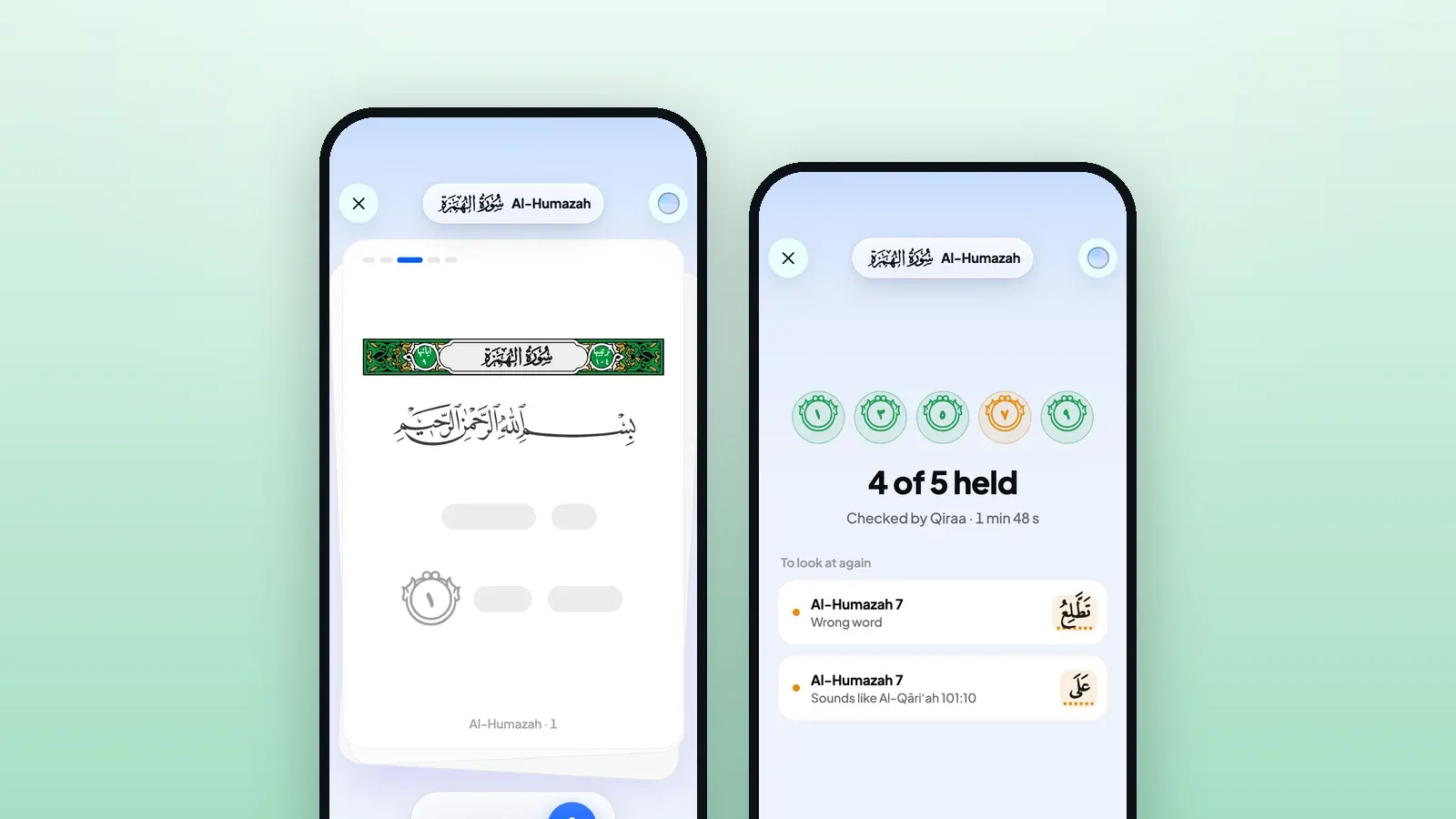
A countdown, then the first card turns over: the cue in ink above, your āyah veiled below.
At the top stands the cue: the āyah before yours, in ink. At a sūrah’s first āyah, the cue is the sūrah’s opening, with its basmalah where it has one. Below it your āyah waits, veiled, with one line: “Carry on from the cue. No text, only memory.”
Just start reciting, or tap My turn. The dock says “Your turn, no help” and counts the words as you say them. Each word returns to the card only after you have said it. That matters: when Qiraa moved to faithful follow, words revealed before they were said went from 45.5% to 0.0%. A test that showed you the next word early would test nothing.
When you stop, the dock says Checking…; on a long āyah the final check can take a few seconds. Then the verdict lands, the marks appear on the words, and Next deals the next card — on the last one, See result.

Words come back only as you say them. When the check is done, the verdict lands on the card — here, Slipped.
The helps
The four helps, and what each one costs
A test with no way forward would leave you stuck. Test me puts four helps on the dock, and each is honest about its cost.
- Cue — the Sheikh recites the āyah before yours (or the basmalah at a sūrah’s opening), then your turn opens again. It costs nothing: the cue is the question, not the answer.
- Show — “Show the next word. It counts as help.” One word appears ahead of you, and the card can be Nearly at best.
- Don’t know — the card is set down as Slipped, the āyah is shown, and it waits for you in the result. Use it rather than guessing: a wrong guess, repeated, becomes a wrong memory.
- End test — stop now and see the result. Cards you did not reach count as Skipped, and the result says “Stopped after 3 āyāt”.

The helps on the dock — Cue, Show, Don’t know, End test — and each is honest about what it costs.
You can also swipe a card away; it reads Skipped. The ✕ asks before letting you go: Keep going, or Stop — “Leave without the result”.
The verdicts
Held · Nearly · Slipped · Skipped
Every card ends with one of four words — strict where strictness helps you, gentle where the check is unsure.
- Held — every word, in order, with no slip and no help: “Every word, from memory.”
- Nearly — you got through, but a word was shown (“A word was shown. It counts as help.”) or the check heard you and could not be sure of a word (“Not every word was clear.”). Nearly is not a failure. It means: keep it warm.
- Slipped — a word was wrong, a word was left out, you slid into a look-alike āyah, or a vowel was wrong. Yes, a wrong vowel is a slip, here as on the reading screen: “A vowel to look at.” The note shows what happened — Expected and You said side by side, “… was left out.”, or “Sounds like” and the look-alike’s reference.
- Skipped — the card closed without a check: swiped away, or the test ended first.
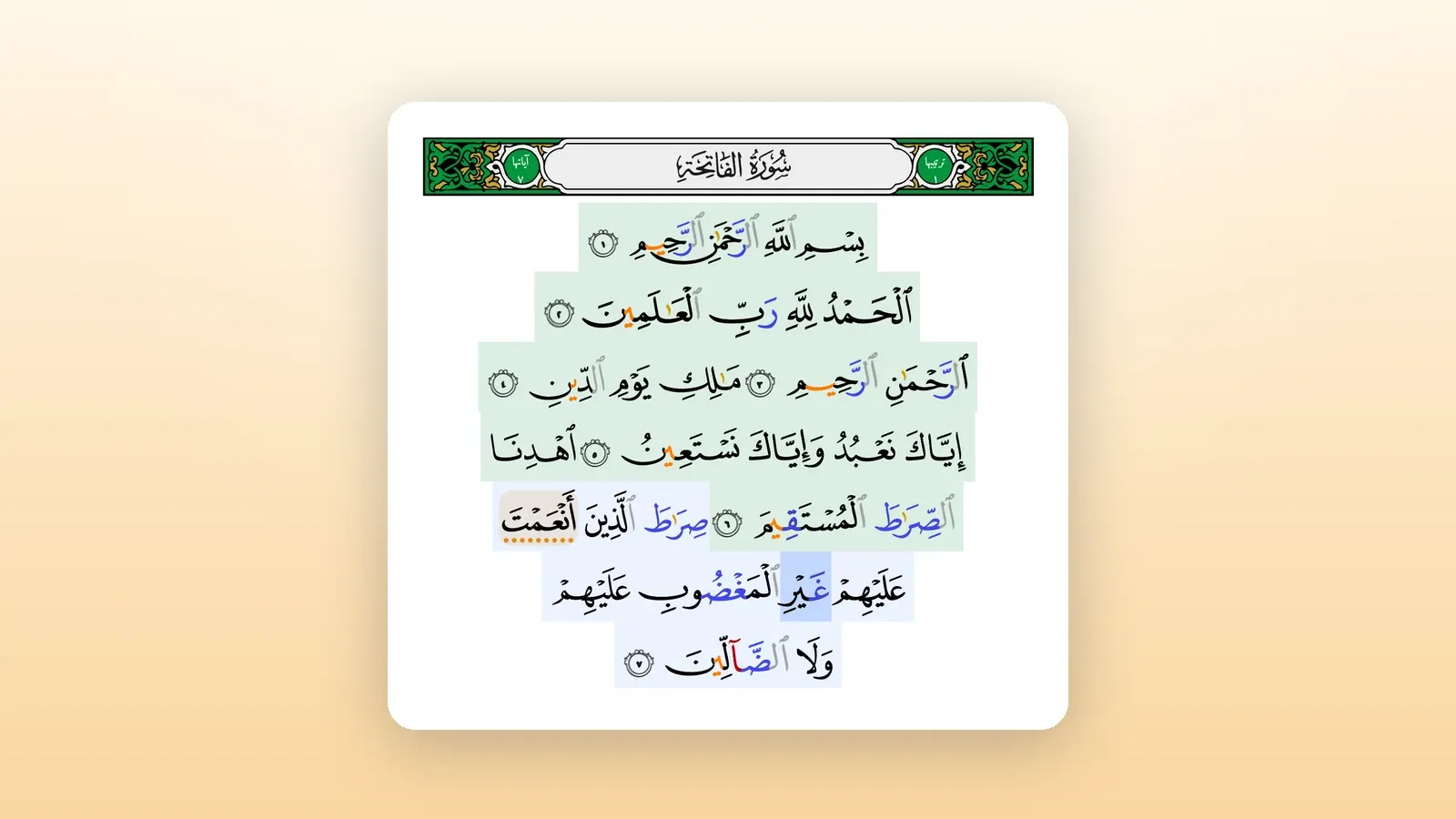
The marks follow Qiraa’s one grammar: amber for a counted slip, a dashed outline for a word left out, and a faint grey line for a word not heard clearly — never counted against you.
Who checked it
Who checked it: Qiraa, or you
Under the result you will see one of two lines:
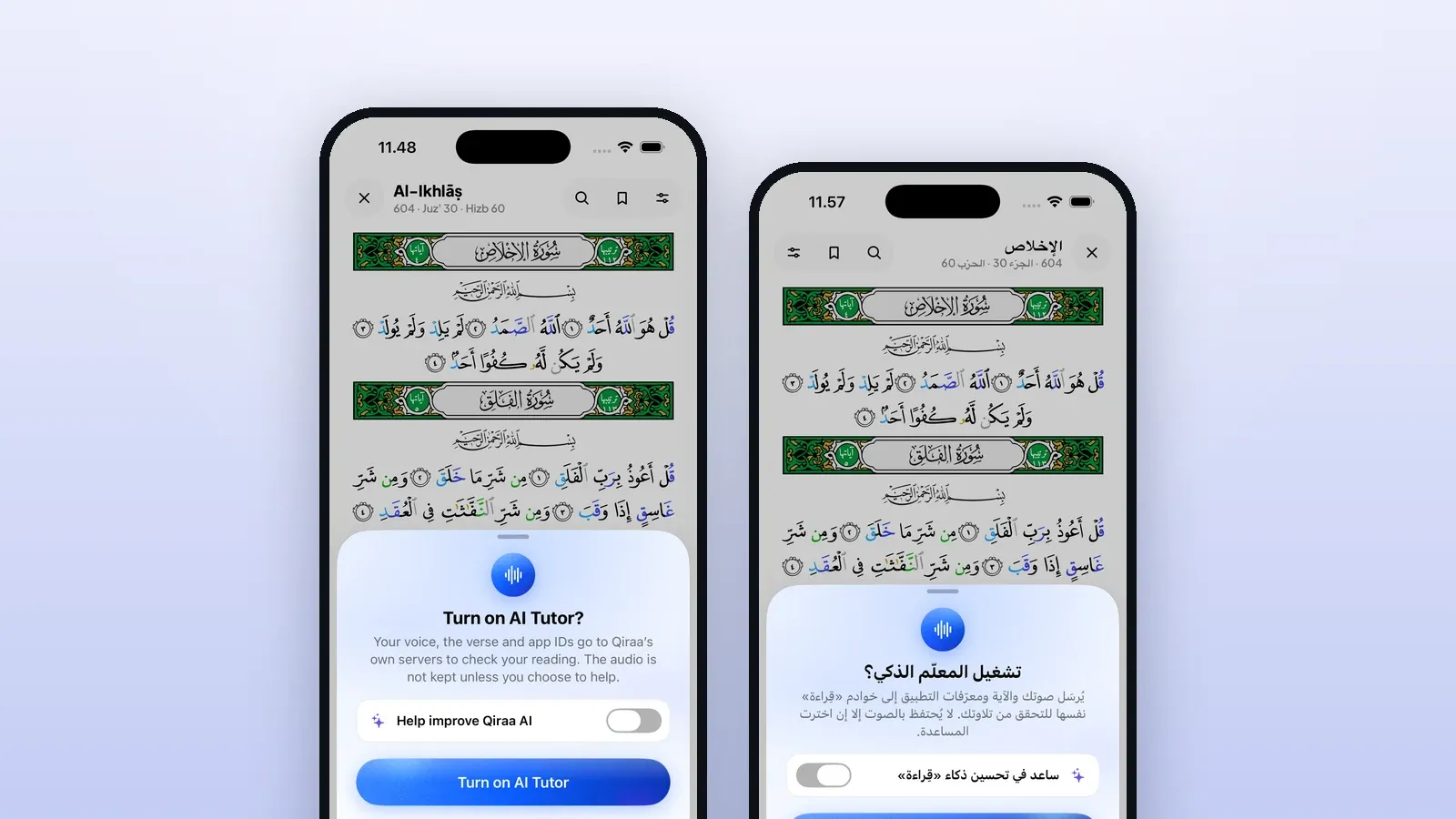
- Checked by Qiraa — a live check decided the cards: Qiraa’s AI, or Qiraa’s follower on your device. Qiraa asks before its AI listens to your voice, and production keeps no recording of your recitation.
- Checked by you — no live check was available, for example because the mic was off or you said no to the AI. The test says so at the start — “Check it yourself this time” — and each card ends with Done, show the āyah and one question, Did you say it?: I said it or I missed.
Even with a live check, a card no check could decide asks you the same plain question rather than guessing.

When nothing could check a card, it asks you plainly: Did you say it? If you paused to search, answer I missed.
A self check is only as good as your honesty. Our rule: if you paused to search, or corrected a vowel, answer I missed. It costs you nothing but a return visit.
The result
Reading the result
The result is one screen: a medallion for each card, in the muṣḥaf’s order — a green tick for Held, an amber ring for Nearly, an amber mark for Slipped, a grey ring for Skipped. Under them, the headline — “4 of 5 held”, or “Every one held” — and a quiet line such as “Checked by Qiraa · 2 min 10 s”.
Then the useful part, To look at again: every āyah that was Nearly or Slipped, with its reference (“113:3”), its verdict, a ▶ Qāriʾ button and the āyah in full, the slipped word marked. Tap ▶ Qāriʾ and the Sheikh recites it; tap again to stop. If nothing needs another look: “Every word in its place.”

The result in one screen: a medallion per card, then To look at again — each āyah, what went wrong, and where a look-alike pulled you.
At the foot: Test again for a fresh deal, or Done. A finished test becomes this portion’s Last time, so the next one shows whether the number moved.
Read the number last. “3 of 5 held” with two Nearly is a good day; “3 of 5 held” with two slips at the same join is a lesson plan.
The week after
What to do with your result over the next week
A result is only worth what you do next. Here is a simple week built around one test.
- Day 0, straight after: play ▶ Qāriʾ on each āyah in To look at again, twice, with the muṣḥaf open. Then take those āyāt into a Hifz sitting, One by one, and use Fix it on the exact word.
- Day 1, before you look at anything: test again where it slipped — make that stretch your portion and take 3 cards. Recall before rereading; that order is the point.
- Day 3: Test again on the whole portion with the same count, so Last time compares like with like.
- Day 7: more cards — 10, or All on a short sūrah. If it holds, move on. If the same āyah slips again, take it to your teacher.
Match the repair to the slip
- A vowel: recite it slowly in the Hifz trainer with Colour tajwīd on, and say the word with its vowel aloud.
- A word left out: usually a join. Recite the āyah before and the slipped āyah together, as one card.
- A look-alike: in the Studio’s Similar phrases tool, tap Drill them apart — a Test me dealt over that āyah’s look-alikes, where each one said its own way is “Told apart”. In our index, 988 āyāt (16%) share their first four words with another āyah, so this slip is common, not careless.
- Nearly: test it again tomorrow without Show. A Nearly that becomes Held is the best sign there is.
What a score is not
What a score is not
A result is a map of today, not a verdict on you. Tired evenings, noisy rooms and long āyāt all show in the number. Test me is practice between lessons: it tells you where to look and keeps you honest with yourself. It cannot grant an ijāzah, and it does not replace reciting to a teacher who can hear your makhārij. Take your To look at again list to your next lesson — it is exactly what a teacher wants to hear.
Questions
Questions about Test me
How many cards should I choose in Test me?
Five makes a good daily check: enough to find a weak join, short enough to do before you read. Use 3 for the āyāt that slipped yesterday, and 10 — or All on a short sūrah — once a week for the whole portion. Keep the count the same between tests so Last time compares like with like.
Does using Cue or Show lower my result?
Cue costs nothing: it plays the āyah before yours, which is the question, not the answer. Show reveals the next word and counts as help, so that card can be Nearly at best. Don’t know sets the card down as Slipped and keeps it to look at again.
Why is a wrong vowel counted as a slip?
Because it is one. A short vowel can change a word’s meaning, and a vowel memorized wrongly is hard to unlearn. Test me follows the same rule as the reading screen: a wrong vowel is a slip, and the card says “A vowel to look at.” so you can fix it this week.
What is the difference between Nearly and Slipped?
Nearly means you got through but needed a shown word, or the check heard you and could not be sure of a word. Slipped means a word was wrong, left out, said with a wrong vowel, or taken from a look-alike āyah. Keep Nearly warm; repair Slipped.
Is my voice recorded during Test me?
Qiraa asks before its AI listens to your voice, and production keeps no recording of your recitation. If you prefer no AI, Test me still works: you recite, show the āyah, answer “Did you say it?” yourself, and the result says “Checked by you”.
Can Test me replace reciting to a teacher?
No. Test me is practice between lessons. It shows you where your memory breaks so your lessons go further, but it cannot grant an ijāzah, and it cannot hear your makhārij the way a qualified teacher can. Bring your To look at again list to your next lesson.