Before you begin
A sitting in Qiraa’s Hifz trainer is short on purpose: most days, two or three āyāt and a few minutes. The Sheikh recites, you recite, the words hide, and you recite again from memory. That loop is enough — once you know what each part is for.
This guide walks through one sitting in order and names every button by the word the app uses. Where a choice is yours, we say what we would pick. At the end are three sittings you can copy tonight: a beginner, a busy adult and a returning hafiz.
Nothing here replaces a teacher. The trainer is practice between lessons: it cannot grant an ijāzah, and it should not be the only one who hears you. Used well, it makes the time you spend with a teacher go further.
Today’s sitting
Today’s sitting, and why it is this size
The sitting opens on the muṣḥaf page with today’s portion washed in colour, a one-line plan on the dock — for example 2 āyāt · about 3 min — and a blue Begin.

The sitting opens on the page: today’s portion in colour, and the plan on the dock — 2 āyāt · about 3 min.
How the size is chosen
The size comes from your plan, which reads your record before it sets the day. Open Settings at the door — the sheet is titled Today’s sitting — and Why this sitting shows up to three facts: Last time, Today and Goal. The Today line gives the real reason, for example:
- “This is your first lesson — it starts light on purpose.”
- “1 recent āyah is still fragile — new material slows until it holds.”
- “Rest day — today is review only, so what you hold stays warm.”

Settings at the door explains the day in plain lines — here, after a few quiet days, the plan moved so nothing piles up.
The minutes are an estimate, not a target: your Sheikh’s recitation of those āyāt times your repeats, and never less than about three minutes. To change the portion, “Tap an āyah, or drag across a few”, or use Select all and Clear. Listen plays the portion first, and Tafsīr opens the meaning of its first āyah.
The plan learns your pace
After a sitting of new āyāt, the trainer may ask Was today’s pace right? — Slower · Just right · Faster. It asks in your first three such sittings, then only when your results suggest a change, at most once a week, and never on a plan with a fixed finish date. Your answer moves tomorrow one honest step: “Tomorrow: 4 āyāt.”
Cards
One by one or Together — and how the cards are held
Before you begin, a chip on the dock offers One by one, Together or Page, with the way that suits the portion already chosen. The trainer’s rule, in its own words: “One by one suits new āyāt.” and “Together suits āyāt you hold.”
- One by one — a card per āyah, each heard, recited and checked before the next. Best for anything new.
- Together — the āyāt on one card, recited as one turn. Best for āyāt you hold: the joins become the test.
- Page — the portion on the muṣḥaf page itself.
Inside the sitting, the View menu holds the cards three ways: Single card (the whole portion), One āyah at a time (“Āyah under āyah, gliding on”) and Merge āyāt (“Join an āyah to the next” — before a card’s turn, + Āyah 5 joins the next āyah and Split separates them again). A rail of dots shows your place: green held, blue held with help, amber to practise. If a joined card slips part-way, carry on From āyah 3 or Start again.
The Sheikh’s turn
The Sheikh’s turn: how many times he recites
Every new card begins with listening. The Sheikh recites while one blue pill glides over the word he is saying, so eye and ear meet the same word. Allah says: وَرَتِّلِ الْقُرْآنَ تَرْتِيلًا — “and recite the Qurʼān with measured recitation” (al-Muzzammil 73:4). Here you hear measured recitation before you try it.

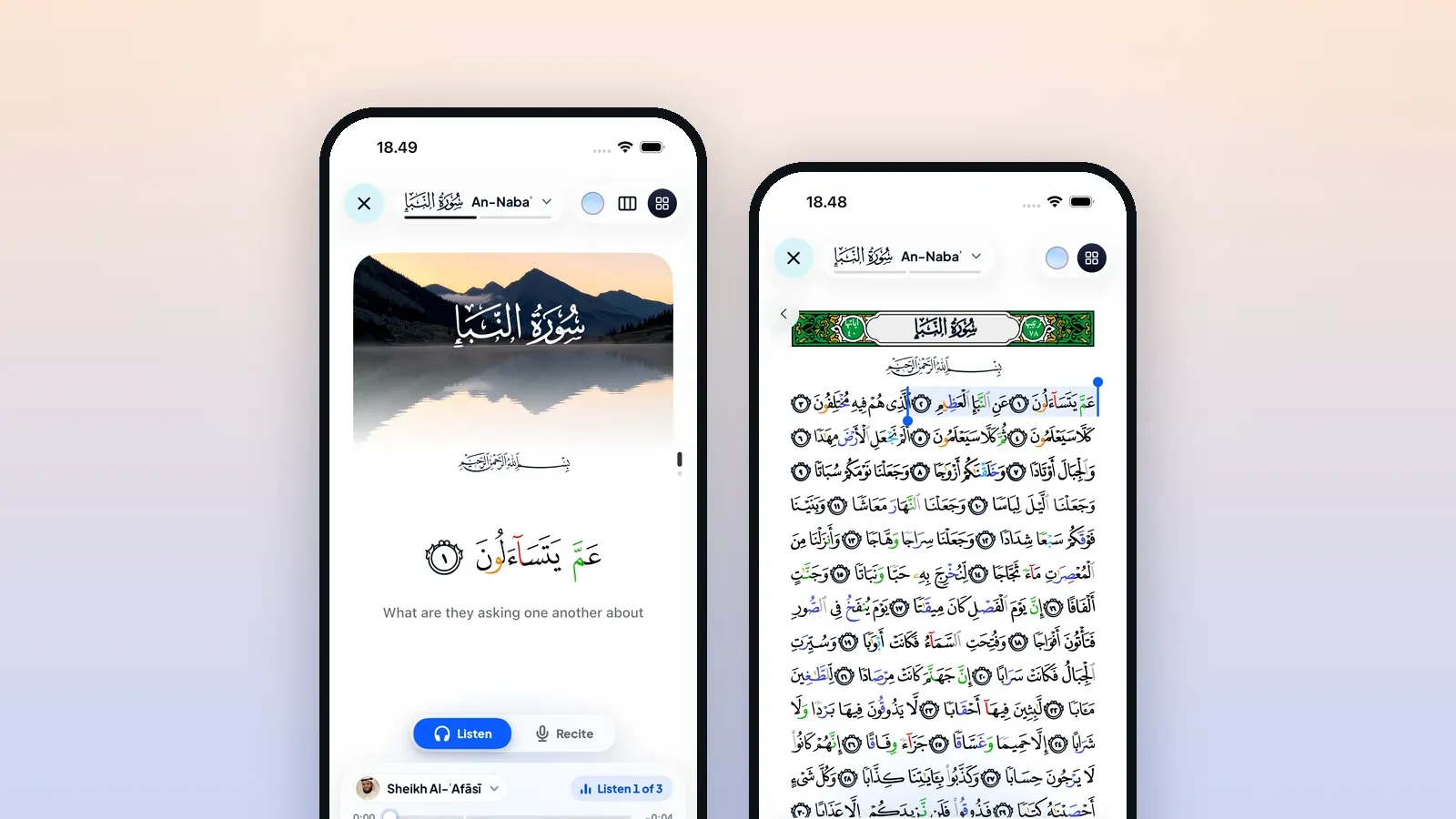
Every new card begins with the Sheikh: a blue pill follows the word he is saying, and the dock counts the repeats — Listen 1 of 3.
Under Settings › Qāriʾ, tap his name to choose another Sheikh, then set He repeats each āyah — Once, ×3 (the default), ×5 or ×10 — and Speed: 0.75×, 0.85×, 1× or 1.25×. The dock counts the passes: “Listen 2 of 3”.

In Settings › Qāriʾ: how many times he recites each new āyah, and how fast.
Only new āyāt get the full repeats. A card the plan is consolidating is heard once, and the daily review is recall, with no listening first. Our advice: ×3 at 1× for most adults; ×5 at 0.85× for a long or hard āyah; ×10 for a learner still matching sounds to letters.
Your turn
Your turn: Listen | Recite, and the three steps
Above the dock sits a switch, Listen | Recite. Listen hands the card back to the Sheikh; Recite stops him and opens your turn, and Qiraa follows you word by word. On a new card your turn has three steps:
- The Sheikh recites, the āyah shown.
- You recite it, still shown — slowly. This is where you catch a vowel before it sets.
- From memory. When that went well, the trainer says “Well read. Now from memory”, hides the āyah at your rung of the hide ladder, and you recite it again.

Recite on the switch opens your turn: the dock says Your turn, then Nuri is listening while the mic is red.
For the from-memory part there are three tools, and every bit of help is counted honestly:
- Peek — “Tap a word to peek · its number for the āyah”. Peek at more than about a quarter of a card’s words and it is not called held: “Too many peeks. It comes back soon”.
- Hide — ready early, in step two? Tap Hide: the words not yet said disappear — “The rest from memory” — without restarting the turn.
- A pause of a few seconds brings a help strip: “Take your time. It begins with” and the next word’s first letter, with Peek word, Hear it and Skip āyah.
A slip the follow is sure of is named once, without giving the word away: “A word was left out — go back for it” or “That’s not the next word — say it again”. If the AI is not listening — you said no, or the mic is off — the dock asks How did it go? with Again, With help and Held. Answer as a strict teacher would.
The hide ladder
The hide ladder: Shown · Faded · Letters · Hidden
How much you see on the from-memory step is yours to choose, under Settings › Hide, with a live preview of the āyah in front of you:
- Shown — every word in full ink.
- Faded — every word still there, pale.
- Letters — each word reduced to its first letter.
- Hidden — a quiet capsule the width of each word; the next word to say is a pale blue capsule with a line under it.

The hide ladder, with a live preview of the āyah: Shown, Faded, Letters, Hidden. Hidden is the default.
Hidden is the default, and the from-memory step always asks for memory: at Shown, the āyah still hides whole there. One rule matters most: only a recital at Hidden, with no help, counts as recall on your own. Faded and Letters are scaffolding.
How to climb it
- A hard new āyah: start at Faded, linking sound to shape.
- Faded passes cleanly twice: move to Letters. The first letter is your only cue, the way a teacher prompts.
- Letters passes cleanly: Hidden, and stay. If an āyah keeps slipping there, step down one rung for a sitting, then set it back.
After a slip
After a slip: it tells you why
When the check finds a slip, the verdict says what kind it was, in one line:
- “A word was left out.”
- “A vowel mark slipped on this word.” — the right word, with a wrong short vowel.
- “One letter slipped.”
- “You said a different word here.”
Under it stand Expected and You said, side by side, then Hear it (the Sheikh says the word), Fix it (he says it alone, then you say it once — counted as help) or Move on.

After a slip the card says why in one line and sets Expected beside You said; Hear it plays the word.
A card ends Held, Held, with help (“It comes back sooner”) or To practise (“It comes back tomorrow”). When the check cannot settle a recital, it never calls it a slip; it says why instead: “Nothing was heard. Hold the phone closer.” or “That sounded like another āyah.”
Do not be discouraged by amber. The Prophet ﷺ said that the one skilled in the Qurʼān is with the noble, righteous scribes, and the one who stumbles through it with difficulty has two rewards (Muslim 798). A slip found today is one that will not set.
Nuri’s coaching
Nuri’s coaching: short lines, at the right moment
Nuri, Qiraa’s guide, coaches the sitting in his own voice, in lines of eight words or fewer. He never speaks over the Sheikh, never while you recite or are being checked, and he falls silent the moment the Sheikh starts or the mic opens.
On the Nuri page of Settings you choose how much he says: Talk me through it (at each step, and before each join), Guide me (the default: between steps, silent while you recite), Only when I’m stuck (quiet unless you stall or the check can’t decide) or Read without voice (captions only).
Tone is Gentle or Direct — the same facts, fewer words; until you choose, a beginner hears Gentle. Spoken language follows the app, or is English or Arabic. Switch his guidance off and he goes fully quiet; your results still show after each āyah. What he says at the door comes only from your own record, such as the āyah that held last time.
Settings
Every setting, and what we would choose
Besides Qāriʾ, Hide and Nuri, two groups in Settings shape the sitting.
On the card
- Text size — Small, Default, Large or Larger, shared with the reading screen.
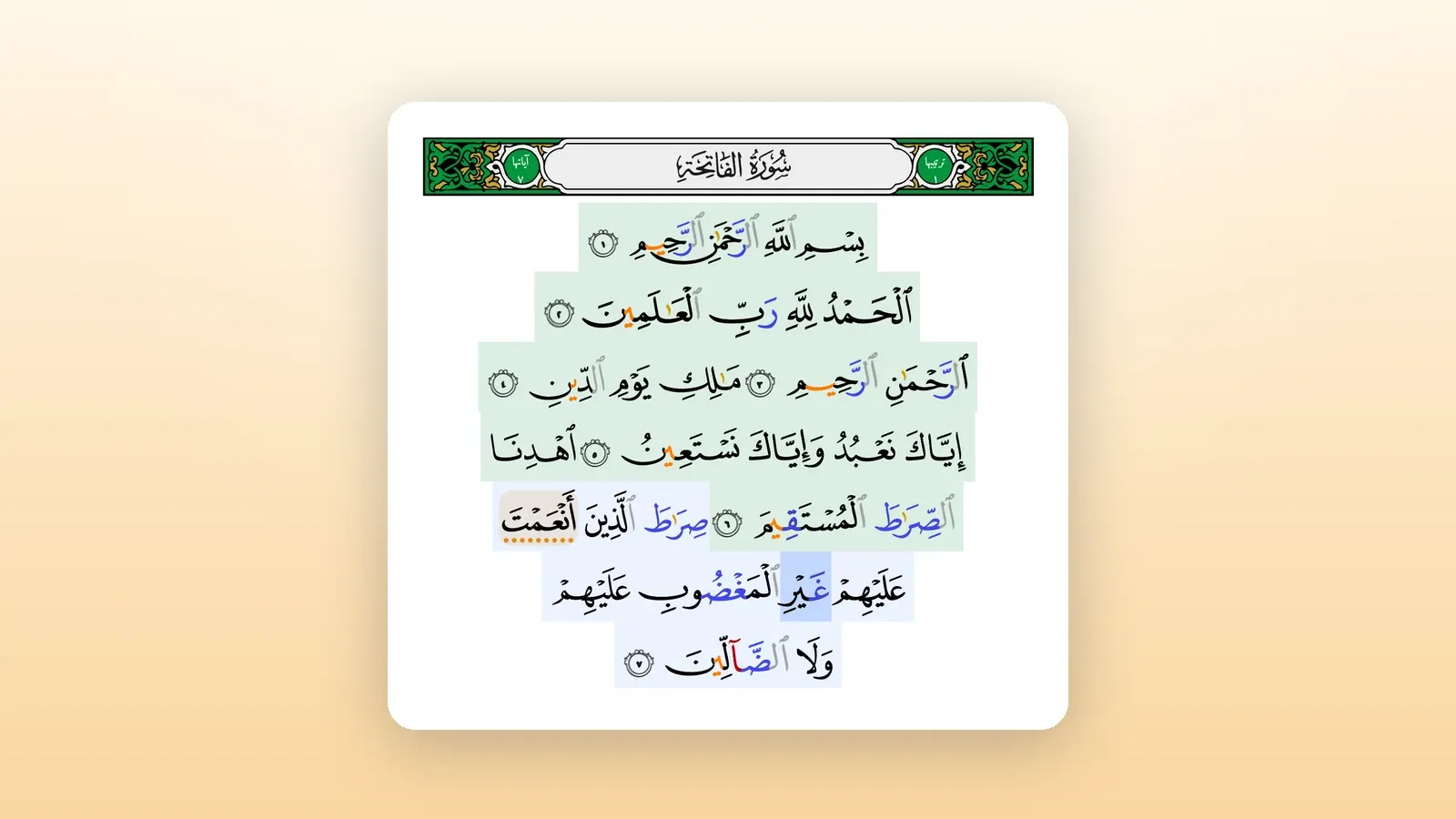
- Colour tajwīd — “Each rule in its colour, on the words in sight.” On by default; keep it on while you learn.
- Colour look-alikes — “Words other āyāt share, and the word where this one parts.” Off by default. In our index, 988 āyāt (16%) share their first four words with another āyah, and we hold 2,451 twin pairs. Turn it on for an āyah with a twin.
- Meaning — the meaning under a one-āyah card, on by default. Read it once before you recite.
This sitting
- Auto-continue — “The next card begins by itself.” Off by default; turn it on when the rhythm feels familiar.
- Daily goal — 5 min to 60 min, 15 by default. Set it for your worst day, not your best.
- Scene & sound — with Each sūrah, every sūrah’s cards wear its own scene. Sound in the room offers Rain, Waves, Wind, Birds, Hearth, Night or River, with a Sound level. Keep it low, under the Sheikh.

On the card and This sitting: Text size, Colour tajwīd, Colour look-alikes and Meaning; then Auto-continue, Daily goal and Scene & sound.
Quiet days
When days go quiet: the plan bends, nothing piles up
Life interrupts hifz, and the trainer tells you what it did in one honest line:
- One missed study day: “You missed a study day — nothing is lost. Today is a little longer so the plan keeps its date.”
- Two or more in a row: “A few quiet days — the plan moved with you, so nothing piles up. Today is its normal size.”
- Further behind: “You’re a little behind, so today is revision first — new āyāt return once these stand again.”
After a longer gap it never piles the missed days onto today. Leaving half-way opens a menu titled “Your place is saved.”: Keep for later, or, once something is held, End and review.
Sitting done
Sitting done: what the close tells you
The close gives one line of truth — “3 held, 1 to practise” — a bead for each āyah, Coming back (Tomorrow, In 3 days…) and Copy summary, “For your teacher or family”. When you needed less help than last time, it says so: “Last time you needed help 3 times; today, once.” Send that summary to your teacher before your next lesson.

The close in one line of truth — 3 held, 1 to practise — with every card’s result beneath.
Sample sittings
Three sample sittings you can copy
1. The beginner: two short āyāt, plenty of support
Two āyāt of a short sūrah you pray with. One by one, held as One āyah at a time. The Sheikh at ×5 and 0.85×. Hide at Faded, then Letters. Nuri on Talk me through it, Gentle. Colour tajwīd and Meaning on, Text size Large, Daily goal 10 min. Fix every vowel in step two.
2. The busy adult: ten honest minutes
The plan’s portion, sized by honest answers to Was today’s pace right? One by one; ×3 at 1×; Hidden. Guide me, Direct. Auto-continue on, Daily goal 10 min. Peek rather than give up — it is counted, and that is fine. On a hard day, finish one card and choose Keep for later.
3. The returning hafiz: proving old portions
A page or a short sūrah you once held. Together, on a Single card. The Sheikh Once — or tap Recite before he starts. Hidden, with Colour look-alikes on. Nuri on Only when I’m stuck. Joins break first; where one does, take that pair One by one tomorrow, then check the portion with Test me.
Questions
Questions about the Hifz trainer
How long should one Hifz sitting be?
Usually a few minutes: two or three āyāt, heard, recited and recalled. The dock estimates it before you begin — for example “2 āyāt · about 3 min” — from your Sheikh’s recitation and your repeats. Set Daily goal to what you can keep on your hardest day; a short sitting every day does more than a long one once a week.
Should I choose One by one or Together?
The trainer suggests one: “One by one suits new āyāt.” and “Together suits āyāt you hold.” Take new āyāt One by one, so each is checked before the next. Use Together for āyāt you already hold: it makes the joins between them the test, and joins are where old memorization breaks first.
Which hide level should I use?
Hidden is the default and the goal, because only a recital at Hidden with no help counts as recall on your own. For a hard new āyah, start at Faded, then Letters, then Hidden. Change it under Settings › Hide, where a live preview shows the āyah at each level.
Why was a recital that sounded right marked as a slip?
Usually because of a vowel. A word said with the wrong short vowel is a slip in Qiraa, and the card says so: “A vowel mark slipped on this word.” Compare Expected and You said, tap Hear it, then Fix it and say the word once yourself.
What happens to my plan if I miss a few days?
It bends. After one missed study day, today may be a little longer so the plan keeps its date; after two or more in a row, the plan moves with you and today stays its normal size. Further behind, revision comes first. Nothing you hold is lost.
Can I use the Hifz trainer without the AI listening?
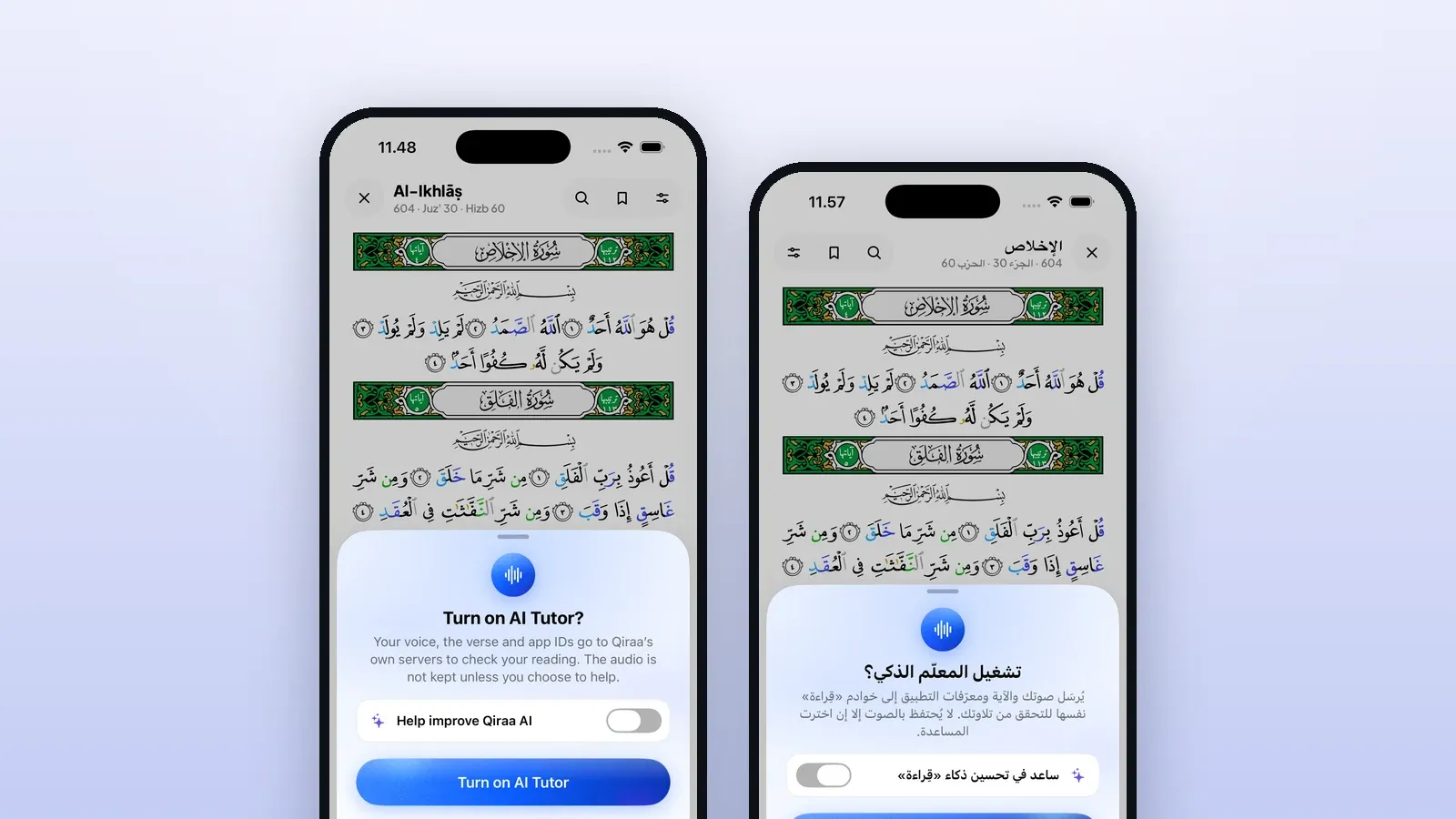
Yes. Qiraa asks before its AI listens to your voice, and production keeps no recording of your recitation. Without it, you recite and then grade yourself when the dock asks “How did it go?” — Again, With help or Held. Either way the trainer is practice between lessons: it cannot grant an ijāzah.